Host tree selection
Establish this mycorrhizal fungus only near suitable hosts such as oak, beech, hornbeam, or sweet chestnut, and avoid planting in areas dominated by conifers or non-mycorrhizal ornamentals.

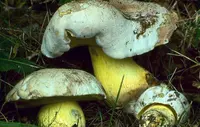
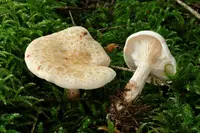
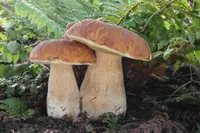
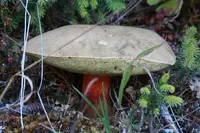
Rooting bolete, Caloboletus radicans, is a mycorrhizal fungus that lives in partnership with tree roots rather than a typical houseplant. It forms thick, pale caps with a stout, often distorted stem that bruises blue when handled. The pores under the cap are yellow and also turn blue when damaged.
This species occurs mainly in temperate Europe, often with oaks and beeches in calcareous or neutral soils. It is generally considered hard to cultivate because it depends on specific tree partners and soil conditions. Gardeners usually do not actively care for Rooting Bolete, but it can appear naturally where conditions suit its fungal network.

Care Difficulty
Moderate Care

Light Preference
Partial Shade

Water Requirements
Moderate Water

Temperature Preference
Cool Climate

Hardiness Zone
6–9

Soil Texture
Loamy, Silty, Organic-rich

Soil pH
Slightly acidic (6.5–7.0), Neutral (7.0)

Soil Drainage
Moist but well-drained

Fertilization
Minimal (feed rarely)
Scan your plant to receive care tips personalized for your specific plant
Available on iOS and Android
This mycorrhizal fungus prefers bright, dappled woodland light rather than full exposure.
This species depends on consistently moist, not waterlogged, soil around its host tree roots.
This bolete develops best in mild to warm conditions typical of temperate woodlands.
Humidity plays almost no role in the development of this outdoor ectomycorrhizal fungus.
This species needs mineral, well-drained ground around suitable host trees rather than a conventional potting mix.
This fungus is not realistically suitable for container growing, as it relies on complex root symbiosis with living trees.
This mycorrhizal fungus grows with host tree roots and usually needs no direct fertilization when in natural soil.
Caloboletus radicans is not pruned like ornamental plants, since the visible part is a temporary mushroom rather than a long-lived shoot system.
Transplanting focuses on the host tree and soil, since this bolete fruits from a hidden mycelium linked to roots rather than from a typical potted plant.
Propagation of Caloboletus radicans in gardens or containers is rarely successful and is not a routine practice for home growers.
This woodland fungus is naturally cold hardy in temperate climates and typically needs no targeted winter care beyond normal tree and soil management.

Plant Health Check
Not sure what's wrong with your plant? Check your plant's health inside the app.
This bolete forms ectomycorrhizal partnerships mainly with oaks on alkaline, lime-rich soils, which is why it is often found in old oak woodlands and parklands on chalk or limestone.
The pale yellow flesh and pore surface bruise deep blue almost immediately when handled or cut, due to rapid oxidation of fungal pigments, a reaction that helps distinguish it from several similar boletes.
Although not considered dangerously toxic, its flesh is strongly and persistently bitter, which makes it unsuitable for eating and has led some authors to classify it as inedible or mildly poisonous.

Molecular studies have shown that this species, once placed in the large and heterogeneous genus Boletus, is distinct enough in its genetic makeup and morphological traits that it was reassigned to the separate genus Caloboletus in 2014, reflecting a major revision of bolete classification based on DNA evidence.
This species is regarded as inedible and potentially harmful due to its very bitter taste and possible gastrointestinal upset. It is not recommended for consumption, even after cooking, and should be left for observation only.
Keep your plants happy and healthy with plant identification, disease detection, and easy care guidance.