Host tree pairing
Choose and maintain compatible host trees such as Douglas fir or other local conifers, since this ectomycorrhizal fungus needs healthy tree roots nearby to form the nutrient-exchanging partnership it relies on.

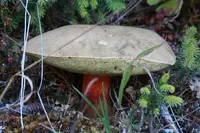
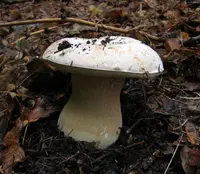
The western bitter bolete, Caloboletus rubripes, is a fleshy wild mushroom rather than a leafy plant. It forms sturdy, club-shaped stems topped with thick, cushion-like caps, often with pinkish to reddish tones on the stem.
This species is native to western North America, usually appearing on the ground in coniferous forests where it forms symbiotic relationships with tree roots. Its strongly bitter taste makes it unsuitable for eating, which simplifies how to care for western bitter bolete in naturalistic settings, since wildlife rarely consumes it.
It prefers undisturbed, moist, well-drained forest soils with dappled light, and is not generally suited to conventional home cultivation or pot culture.

Care Difficulty
Hard Care

Light Preference
Partial Shade

Water Requirements
Keep Soil Moist

Temperature Preference
Cool Climate

Hardiness Zone
Unknown

Soil Texture
Loamy, Organic-rich

Soil pH
Acidic (5.5–6.5)

Soil Drainage
Moist but well-drained

Fertilization
Minimal (feed rarely)
Scan your plant to receive care tips personalized for your specific plant
Available on iOS and Android
This ectomycorrhizal fungus prefers light patterns similar to the native conifer and mixed forests where it naturally fruits.
This mycorrhizal fungus depends on consistent but not saturated soil moisture in association with its host trees.
This woodland bolete is adapted to cool to mild conditions and fruits best when soil and air temperatures stay moderate.
Humidity is not a meaningful care factor for this wild ectomycorrhizal fungus.
This fungus fruits in association with conifer roots in specific forest soils, not in standard garden or potting substrates.
This species is not suitable for container growing, as it depends on a mycorrhizal partnership with live tree roots in undisturbed soil.
Caloboletus rubripes forms a mycorrhizal partnership with trees and should not be fertilized directly.
Pruning is not applicable for Caloboletus rubripes, since it is a wild mycorrhizal fungus rather than a garden plant with stems or branches.
Instead of repotting, focus on suitable woodland conditions when attempting to establish this fungus near host trees.
Propagation of Caloboletus rubripes is complex and not reliably managed in home or garden settings.
No special winter care is required, as this woodland fungus is adapted to natural seasonal cycles in temperate climates.

Plant Health Check
Not sure what's wrong with your plant? Check your plant's health inside the app.
The pore surface and flesh of this bolete stain an intense blue within seconds when handled or cut, due to rapid oxidation of pulp pigments when exposed to air.
Although the fruiting body is non-toxic, its flesh has a pronounced bitter flavor that usually persists even after cooking, which is why it is considered inedible.
This species occurs mainly in western North America, where it forms ectomycorrhizal partnerships with conifers such as pines and firs, exchanging mineral nutrients for sugars from the tree roots.

The vivid pink to reddish stipe of this bolete, often with yellow near the apex, can help distinguish it in the field from many other blue-staining boletes that have more uniformly colored or differently patterned stems.
This species is technically non-lethal but is considered inedible due to its very strong bitter taste, which ruins dishes even in small amounts. Consumption commonly causes gastrointestinal upset, so it should be avoided as a food mushroom.
Keep your plants happy and healthy with plant identification, disease detection, and easy care guidance.