Retain Host Moisture
When managing dead conifer logs or stumps, avoid debarking and allow a 5–10 cm layer of coarse woody debris or bark to remain so the substrate stays damp enough for fruit body formation.

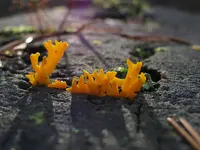
Calocera furcata is a small, jelly-like fungus rather than a traditional green plant. It forms bright yellow to orange, forked clubs on decaying wood, often in clusters. The fruiting bodies have a rubbery texture and can persist in cool, damp conditions.
This species occurs mainly on dead conifer wood in temperate forests, including parts of North America and Europe. It relies on consistently moist, shaded habitats and rotting wood, which makes it difficult to cultivate intentionally. Gardeners who want to learn how to care for Calocera furcata usually focus on maintaining cool, humid, woody habitats rather than the fungus itself.

Care Difficulty
Hard Care

Light Preference
Shade

Water Requirements
Keep Soil Moist

Temperature Preference
Cool Climate

Hardiness Zone
Unknown

Soil Texture
Organic-rich, Loamy

Soil pH
Acidic (5.5–6.5)

Soil Drainage
Moist but well-drained

Fertilization
Minimal (feed rarely)
Scan your plant to receive care tips personalized for your specific plant
Available on iOS and Android
This wood-decay fungus prefers cool, shaded forest conditions rather than direct open sun.
Stable surface moisture is more important than direct watering for this wood-inhabiting species.
This fungus thrives in cool to mild conditions and declines in temperature extremes.
Humidity is not a major factor for Calocera furcata, which typically develops on already moist wood or bark surfaces.
Calocera furcata grows on dead wood rather than in soil, so creating a suitable woody substrate is more important than standard potting soil preparation.
This species is generally unsuitable for conventional container growing because it colonizes dead wood rather than forming a soil-based root system.
This wood-inhabiting jelly fungus naturally gains nutrients from decaying timber and generally does not need added fertilizer in cultivation.
As a saprobic jelly fungus, Calocera furcata does not require horticultural pruning in the usual sense.
This species is not maintained as a conventional potted plant, so attention focuses on providing suitable decaying wood rather than repotting.
Propagation of Calocera furcata for study or display is specialized and not typically attempted by casual growers.
In its natural outdoor habitat this fungus is cold hardy and typically needs no specific winter care beyond stable habitat conditions.

Plant Health Check
Not sure what's wrong with your plant? Check your plant's health inside the app.
The fruiting bodies of Calocera furcata often branch repeatedly into forked, antler-like tips, which helps distinguish it from the more club-shaped Calocera viscosa and other yellow jelly fungi.
This species grows on very decayed, usually coniferous wood, functioning as a saprobe that recycles tough lignocellulose into simpler compounds that other organisms in the forest ecosystem can use.
Its bright yellow to orange tissue is strongly gelatinous due to a high water content and jelly-like polysaccharides in the cell walls, allowing the fungus to shrink in dry weather and rehydrate and resume spore release when moisture returns.
This jelly fungus is not considered a good edible. It is reportedly non-toxic but has very little flavor and a tough, gelatinous texture. It is best treated as non-culinary and left for observation rather than harvest.
Keep your plants happy and healthy with plant identification, disease detection, and easy care guidance.