Use Fresh Hardwood
Inoculate only freshly cut, disease-free hardwood logs or blocks, as this fungus colonizes best on undecayed wood with intact lignin and cellulose.

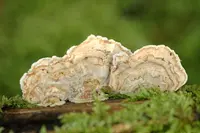
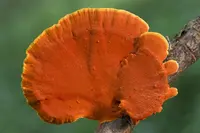
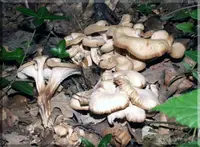
Mossy maze polypore (Cerrena unicolor) is a bracket fungus, not a typical leafy plant. It forms thin, shelf-like caps on dead or living hardwood trunks and branches. The upper surface often looks greenish and mossy from algae and moss growing over it.
This species has a maze-like pore surface underneath, which gives it a distinctive texture. It occurs widely across temperate regions, including North America and Europe, where it helps decompose wood.
In cultivation, it is considered challenging because it depends on suitable wood substrates and humidity rather than soil. Enthusiasts who care for Mossy Maze Polypore usually focus on maintaining stable moisture, good airflow, and shaded conditions that mimic a forest log habitat.

Care Difficulty
Moderate Care

Light Preference
Partial Shade

Water Requirements
Keep Soil Moist

Temperature Preference
Cool Climate

Hardiness Zone
Unknown

Soil Texture
Loamy, Organic-rich

Soil pH
Acidic (5.5–6.5)

Soil Drainage
Moist but well-drained

Fertilization
Minimal (feed rarely)
Scan your plant to receive care tips personalized for your specific plant
Available on iOS and Android
This bracket fungus favors stable, low-intensity light similar to shaded woodland conditions.
This wood-decaying fungus relies on steady substrate moisture rather than direct top-watering.
This species performs best in cool to mild conditions typical of temperate woodlands.
This bracket fungus tolerates a wide humidity range but grows most actively in moist, forest-like air.
Cerrena unicolor is a wood-decaying fungus that anchors best in dense, lignin-rich substrates rather than standard potting soil.
This species can be grown in containers if the setup imitates a stable, moist log environment.
Cerrena unicolor, commonly called mossy maze polypore, usually grows on decaying wood and needs no added fertilizer in natural or outdoor culture.
Pruning is generally unnecessary for Cerrena unicolor, which naturally forms tiered brackets on dead or weakened wood.
Transplanting focuses on moving colonized wood rather than handling Cerrena unicolor as a typical potted plant.
Propagation of Cerrena unicolor is specialized and usually done by fungal growers rather than casual plant owners.
Cerrena unicolor is a cold-hardy wood-decay fungus that typically requires no targeted winter care in temperate climates.

Plant Health Check
Not sure what's wrong with your plant? Check your plant's health inside the app.
This species often develops in association with horntail wasps, whose larvae help introduce the fungus deep into wood, allowing it to colonize trees more effectively.
It is a white-rot fungus that breaks down both lignin and cellulose in hardwoods, playing a key role in nutrient cycling and forest decomposition processes.
The underside of the fruiting body forms irregular, maze-like pores rather than round tubes, which increases spore-producing surface area and is the basis for the common name mossy maze polypore.

Research has shown that this species can support the development of certain solitary bee larvae, which use its tough, layered fruiting bodies as a nesting substrate in decaying wood.
This bracket fungus spreads efficiently along dead or weakened wood through its mycelium, often forming large colonies. It is not invasive in soil but can colonize extensively on suitable hardwood logs, stumps, or declining trees.
Keep your plants happy and healthy with plant identification, disease detection, and easy care guidance.