Select stable stone
Attach thalli only to hard, non-calcareous rocks that will not crumble or shift, such as granite or dense sandstone, to avoid mechanical damage and sudden changes in surface chemistry that can kill new growth.

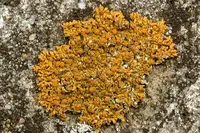
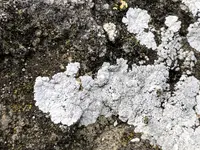
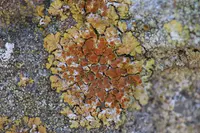
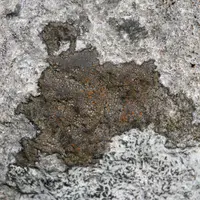
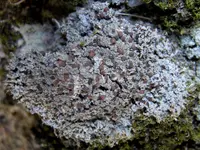
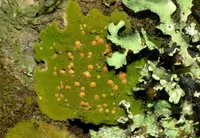
Rock jewel lichen, Calogaya saxicola, is a crustose lichen that forms tightly attached, flat patches on rock surfaces. It often shows bright yellow to orange tones that stand out clearly against stone.
This species typically colonizes sunny, exposed rocks, cliffs, and walls in dry, open landscapes, including coastal and inland sites. It grows slowly but can persist for many years once established.
Calogaya saxicola is naturally adapted to harsh conditions, including strong light, periodic drought, and poor mineral substrates, which makes it relatively low-maintenance in suitable settings. Anyone wanting to learn how to care for Rock Jewel Lichen should focus on providing stable rock surfaces, good light, and minimal disturbance rather than rich soil or frequent watering.

Care Difficulty
Moderate Care

Light Preference
Full Sun

Water Requirements
Low Water

Temperature Preference
Cold Hardy

Hardiness Zone
3–9

Soil Texture
Rocky, Sandy

Soil pH
Slightly acidic (6.5–7.0), Neutral (7.0)

Soil Drainage
Well-drained

Fertilization
Minimal (feed rarely)
Scan your plant to receive care tips personalized for your specific plant
Available on iOS and Android
Calogaya saxicola grows best in open, bright sites with long daily sun exposure.
This rock-dwelling lichen is adapted to natural wet–dry cycles and needs very little supplemental water.
This species tolerates a wide temperature range but remains most active in cool to mild conditions.
This saxicolous lichen tolerates a wide humidity range but benefits from moderate ambient moisture.
Calogaya saxicola grows on rock or very mineral, low-organic substrates rather than typical potting soil.
This species can be grown in shallow containers that mimic rocky, fast-drying habitats.
Calogaya saxicola, or Rock Jewel Lichen, normally obtains nutrients from rain, dust, and the rock surface, so added fertilizer is not recommended.
Calogaya saxicola needs virtually no pruning, since removing tissue can damage the lichen structure and its symbiotic balance.
This lichen is adapted to growing on stable rock surfaces and is not suited to conventional repotting or transplanting.
Propagation of Calogaya saxicola is slow and technically challenging, as it relies on both fungal and algal partners establishing together.
In typical outdoor habitats, this lichen is naturally cold hardy and does not need special winter care.

Plant Health Check
Not sure what's wrong with your plant? Check your plant's health inside the app.
This lichen forms bright yellow-orange crusts that strongly prefer exposed, sunlit siliceous rocks, especially in coastal and upland areas influenced by sea spray or high light and wind.
It is considered relatively tolerant of airborne nitrogen and some air pollutants, so it often persists and even thrives in places where more sensitive lichen species disappear, such as urban stonework and roadside rocks.
The species commonly colonizes sea cliffs, coastal boulders, and man-made structures near the ocean, indicating an ecological adaptation to regular salt spray and desiccation stress.
Growth is very slow. Crusts often expand only 1–3 mm per year, sometimes less in harsh sites. Visible spreading over rock surfaces can take many years, so stable, undisturbed substrates are important for long-term development.
Keep your plants happy and healthy with plant identification, disease detection, and easy care guidance.