Use stable substrates
Mount the lichen on long‑lasting, non‑treated hardwood, cork, or inert rock rather than soft or resinous wood, so the substrate does not decompose or leach resins faster than the thallus can spread.

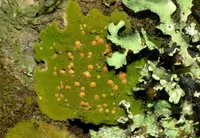
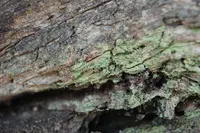
Coenogonium implexum is a leaf-dwelling lichen, not a traditional plant, formed by a partnership between a fungus and photosynthetic algae. It often appears as tiny, flat, greenish patches with delicate fruiting bodies scattered across smooth leaves or bark.
This species is typically found in humid tropical and subtropical forests, where air is clean and moisture is high. It prefers stable, shaded or filtered light conditions and consistent surface moisture.
Because it is sensitive to drying out, pollution, and physical disturbance, it can be challenging to maintain outside its natural habitat. Many enthusiasts explore how to care for coenogonium lichen mainly in specialized terrariums or controlled environments.

Care Difficulty
Hard Care

Light Preference
Partial Shade

Water Requirements
Keep Soil Moist

Temperature Preference
Tropical / Frost Sensitive

Hardiness Zone
Unknown

Soil Texture
Organic-rich, Peaty, Loamy

Soil pH
Strongly acidic (4.5–5.5), Acidic (5.5–6.5)

Soil Drainage
Moist but well-drained

Fertilization
Minimal (feed rarely)
Scan your plant to receive care tips personalized for your specific plant
Available on iOS and Android
This epiphytic lichen prefers soft, consistently humid light conditions rather than direct, intense sun.
This lichen relies on frequent surface moisture but suffers if kept saturated without drying periods.
This species prefers mild, stable temperatures typical of humid, shaded forests.
This lichen needs constantly moist, high-humidity conditions to remain healthy in cultivation.
This species grows best on a consistently moist, airy, organic substrate rather than standard potting soil.
This species can be grown in shallow containers or terrariums if moisture and airflow are carefully managed.
This lichenized fungus grows on bark and typically needs no additional fertilizer in normal outdoor conditions.
Coenogonium implexum needs almost no pruning, since its natural growth is thin and closely attached to bark.
This species is usually established on tree bark, logs, or rocks, so transplanting is rarely recommended and often unsuccessful.
Coenogonium implexum reproduces mainly through natural spore dispersal and tiny lichen fragments, making intentional propagation slow and technically demanding.
In most temperate climates this lichen is naturally cold hardy and needs no special winter care when left on its outdoor substrate.

Plant Health Check
Not sure what's wrong with your plant? Check your plant's health inside the app.
This species is a leaf-dwelling lichen that grows almost exclusively on the living leaves of rainforest plants, especially in warm, humid tropical and subtropical forests.
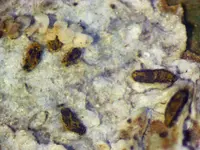
It forms small, often orange to yellowish fruiting bodies called apothecia that stand out clearly against the pale to greenish thallus, making the reproductive structures much more visible than in many other leaf-lichens.
Because it relies on consistently moist, shaded microhabitats on leaf surfaces, its presence often indicates sites with stable humidity and relatively undisturbed forest canopy conditions, which is useful for scientists growing coenogonium lichen in controlled research settings.
Growth is usually slow to very slow. In good, humid conditions it may extend a few millimeters per year. Disturbance, drying, or air pollution can reduce this further, so visible change often takes several years.
Keep your plants happy and healthy with plant identification, disease detection, and easy care guidance.