


Stable host selection
Choose long-lived, slow-growing host trees or shrubs with already-stable bark, since frequent bark shedding or pruning can physically remove the thalli and set back colony establishment.

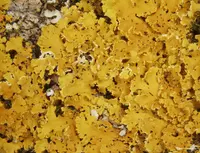
Xanthoria ulophyllodes is a foliose lichen, not a typical leafy plant. It forms flat, overlapping lobes that create bright yellow‑orange patches on rock or bark surfaces. The color comes from protective pigments that help it tolerate strong light.
This species occurs mainly in temperate regions, often in areas with clean air and moderate humidity. It grows slowly and depends on stable surfaces and undisturbed conditions, which makes relocation and cultivation challenging.
Those who want to care for Xanthoria ulophyllodes should know it prefers bright light, consistent moisture from humidity or rainfall, and a firm, low‑nutrient substrate rather than rich potting soil.

Care Difficulty
Moderate Care

Light Preference
Partial Shade

Water Requirements
Moderate Water

Temperature Preference
Warm Climate

Hardiness Zone
Unknown

Soil Texture
Loamy

Soil pH
Slightly acidic (6.5–7.0)

Soil Drainage
Well-drained

Fertilization
Minimal (feed rarely)
Scan your plant to receive care tips personalized for your specific plant
Available on iOS and Android
This lichen prefers stable, cool light conditions rather than intense, direct sun.
Water availability for this lichen should mimic naturally intermittent moisture rather than constant wetness.
This species copes with a broad temperature range but performs best in cool to mild conditions.
Humidity plays only a minor role for Xanthoria ulophyllodes, which is adapted to exposed, fluctuating conditions.
This lichen does not grow in conventional potting soil and instead anchors to firm, stable substrates.
This species is only loosely suited to container growing, and containers mainly serve as supports for its substrate.
This lichen grows on nutrient-poor surfaces and generally does not benefit from added fertilizer.
Xanthoria ulophyllodes needs virtually no pruning, since lichens lack true stems and foliage.
Transplanting is rarely necessary, as this lichen naturally anchors to bark, rock, or other stable surfaces.
Propagation focuses on relocating small thallus fragments rather than traditional plant techniques.
This lichen is naturally cold hardy and usually needs no special winter care in temperate climates.

Plant Health Check
Not sure what's wrong with your plant? Check your plant's health inside the app.
This lichen typically grows on the living leaves of evergreen shrubs and trees, especially in humid, oceanic climates, rather than on bark or rock like many related species.
Its vivid orange-yellow thallus is linked to high concentrations of carotenoid pigments and often indicates environments enriched with nitrogen compounds such as ammonia from agriculture or coastal bird colonies.
The thallus usually lies very close and tightly attached to the leaf surface, an adaptation that helps it withstand wind and leaf movement while maximizing access to water films on the leaf.
This species has often been used in ecological and taxonomic studies as a representative foliar lichen in oceanic regions of Europe, helping researchers understand how lichens adapt to living on short-lived leaf surfaces instead of long-lived bark or rock substrates.
This lichen performs best outdoors, attached to stable substrates like bark, old leaves, or rocks with good air circulation. It does not adapt well to typical indoor environments, so Xanthoria ulophyllodes indoor care is rarely practical or recommended.
Keep your plants happy and healthy with plant identification, disease detection, and easy care guidance.

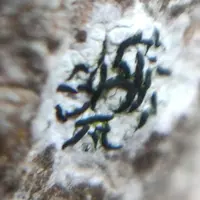
Worm Lichen
Alyxoria culmigena
needle lichen
Chaenotheca stemonea
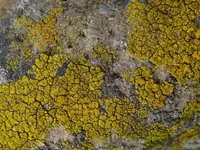
eggyolk lichen
Candelariella vitellina
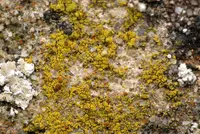
Candelariella coralliza
Candelariella coralliza
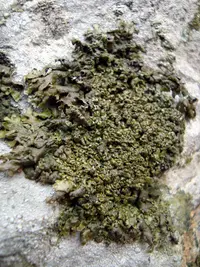
Xanthoparmelia pulla
Xanthoparmelia pulla
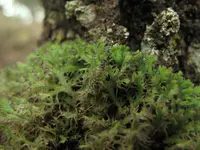
Great Ciliated Lichen
Anaptychia ciliaris
needle lichen
Chaenotheca chlorella
Cumberland rock-shield
Xanthoparmelia cumberlandia