


Site hygiene management
Remove and dispose of any nearby woody debris, thick leaf litter, or decaying roots where this fungus tends to fruit, as reducing organic clutter lowers the chance of repeated emergence in high-traffic garden or lawn areas.

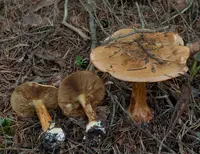
Calonarius sulfurinus is not a green plant but a mushroom-forming fungus, producing small to medium fruiting bodies rather than leaves and stems. It belongs to a group of forest fungi that form close associations with tree roots, often in cool, moist woodland habitats.
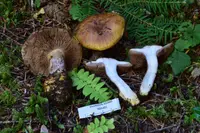
The caps are usually yellowish to sulfur-colored, sometimes with fibrous or scaly surfaces, and the stems are slender, giving it a delicate appearance on the forest floor. Identification is specialized, since related species can look similar and require microscopic features or chemical tests.
For anyone wanting to understand how to care for Calonarius sulfurinus in a cultivation context, it is important to know it naturally prefers undisturbed, well-drained forest soils with consistent moisture and shade.

Care Difficulty
Moderate Care

Light Preference
Partial Shade

Water Requirements
Moderate Water

Temperature Preference
Warm Climate

Hardiness Zone
Unknown

Soil Texture
Loamy

Soil pH
Slightly acidic (6.5–7.0)

Soil Drainage
Well-drained

Fertilization
Minimal (feed rarely)
Scan your plant to receive care tips personalized for your specific plant
Available on iOS and Android
This species prefers bright forest-like conditions with gentle, filtered light rather than harsh direct sun.
Moist but not waterlogged ground supports the fungal mycelium that produces this species.
This species develops best in cool to mild conditions typical of temperate forests.
This fungus has minimal humidity sensitivity and usually relies more on substrate moisture than air humidity.
Calonarius sulfurinus fruits best in consistently moist, organic-rich forest-type substrates rather than typical garden soil.
This species is generally not suitable for long-term container growing, as it depends on complex soil and root associations that are hard to sustain in pots.
This mycorrhizal fungus is not a houseplant and normally grows in nutrient-balanced forest soils without added fertilizer.
Calonarius sulfurinus is a wild, ectomycorrhizal mushroom and is not maintained by pruning in the way ornamental plants are.
This fungus grows in symbiosis with tree roots and is not suited to conventional repotting or transplanting.
Propagation of this wild ectomycorrhizal species is specialized and not practical for typical gardeners.
In natural habitats this fungus overwinters without targeted human care and does not need specific winter protection.

Plant Health Check
Not sure what's wrong with your plant? Check your plant's health inside the app.
The fruiting bodies show a distinct sulfur-yellow to yellow-orange cap surface, which strongly contrasts with the darker, often brownish to olivaceous gills as they mature, helping mycologists distinguish it from related brown-capped species.
This species forms ectomycorrhizal partnerships with conifer trees, especially in montane or boreal-type forests, exchanging mineral nutrients and water from the soil for sugars produced by the host tree.
Molecular phylogenetic studies using DNA sequencing moved this species from the broad Cortinarius genus into the more narrowly defined genus Calonarius, reflecting a refined understanding of its evolutionary relationships.
This fungus is not considered edible and should be treated as potentially poisonous. Identification within the Cortinarius group is difficult, and some close relatives are deadly. For safety, avoid consumption and do not use it as food.
Keep your plants happy and healthy with plant identification, disease detection, and easy care guidance.

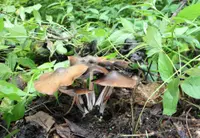
landslide mushroom
Psilocybe caerulescens
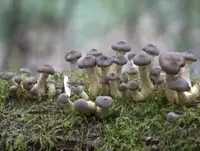
mullet honey fungus
Armillaria cepistipes
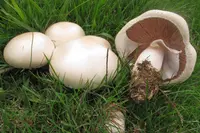
Horse Mushroom
Agaricus arvensis
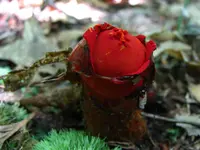
stalked puffball-in-aspic
Calostoma cinnabarinum
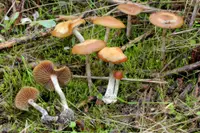
wavy cap
Psilocybe cyanescens
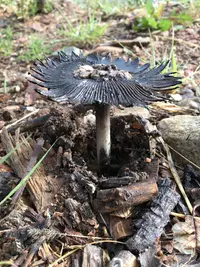
Star-capped Coprinus
Coprinus calyptratus
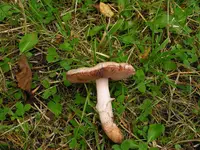
Scaly Wood Mushroom
Agaricus langei
Calonarius cupreorufus
Calonarius cupreorufus