Low-profile training
Pinch back overly long stems and gently peg them to the soil surface with landscape staples or small wire U-pins to encourage a denser mat and reduce wind damage on exposed slopes.

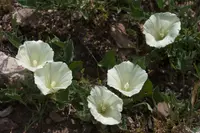
Hillside false bindweed (Calystegia subacaulis) is a low, trailing perennial vine in the morning glory family. It typically forms compact mats close to the ground. The plant has slender, twining stems and arrow-shaped green leaves, with white to pale pink funnel-shaped flowers that open in daylight. Its overall look is delicate but quite resilient in suitable conditions. Calystegia subacaulis is native to dry, open slopes and scrubby habitats in parts of California, often in sandy or rocky soils. It adapts best to sunny spots with well-drained soil and low to moderate water. Understanding how to care for hillside false bindweed is useful, as its spreading habit can make it either a charming groundcover or an overly vigorous plant in small spaces.

Care Difficulty
Easy Care

Light Preference
Full Sun

Water Requirements
Low Water

Temperature Preference
Cold Hardy

Hardiness Zone
7–10

Soil Texture
Sandy, Loamy, Rocky

Soil pH
Slightly acidic (6.5–7.0), Neutral (7.0)

Soil Drainage
Well-drained

Fertilization
Minimal (feed rarely)
Scan your plant to receive care tips personalized for your specific plant
Available on iOS and Android
Calystegia subacaulis thrives in bright conditions typical of open, dry slopes.
Calystegia subacaulis prefers moderately dry conditions and dislikes waterlogged soil.
This species is adapted to mild, dry climates with cool winters and warm summers.
Humidity is usually not critical for Calystegia subacaulis in outdoor conditions, as long as air is not extremely dry.
Calystegia subacaulis prefers lean, well-drained, often sandy soils that do not stay wet.
This species can be grown in containers outdoors if the pot is set up to drain and stay stable for its spreading habit.
Calystegia subacaulis is a low-nutrient-demand native, so use light feeding only to support growth in poor soils.
Pruning Calystegia subacaulis is mainly for tidiness and to encourage compact, flowering growth.
This species is usually grown in the ground, so focus on thoughtful transplanting rather than frequent repotting.
Calystegia subacaulis is commonly propagated by division and stem cuttings for consistent plants.
This hillside false bindweed is generally cold hardy in its suitable climates and needs minimal winter care.

Plant Health Check
Not sure what's wrong with your plant? Check your plant's health inside the app.
This species is naturally restricted to coastal and near-coastal habitats in central and southern California, where it grows on open, often sandy or rocky hillsides and bluffs.
Unlike many twining bindweeds, this plant typically forms low, spreading mats or short trailing stems that hug the ground, an adaptation to exposed, windy sites.
Its white to pale-pink funnel-shaped flowers usually open in the morning and may close or wilt as the day heats up, which helps protect the reproductive structures from midday stress.

The species is considered of conservation concern in parts of its native range in California because its specialized hillside and coastal habitats are increasingly fragmented or altered by development and invasive plants.
This species spreads by underground stems and can form dense patches, especially in loose, well-drained soil. In gardens, edging, root barriers, or planting in contained areas helps manage growth and prevent unwanted spread when growing hillside false bindweed.
Keep your plants happy and healthy with plant identification, disease detection, and easy care guidance.