


Early staking support
Install a slim, sturdy stake or unobtrusive trellis when the rosette starts to elongate so the tall flowering spike can be loosely tied in place before it becomes top-heavy and leans or snaps.

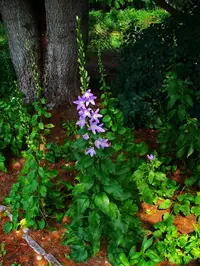
Chimney bellflower, Campanula pyramidalis, is a short-lived perennial often grown as a biennial, valued for its tall, narrow spires of bell-shaped flowers. It creates a strong vertical accent, with leafy stems that can be densely covered in soft blue or white blooms.
This species is native to parts of southern Europe, where it grows in rocky slopes and old walls, which explains its tolerance of well-drained, somewhat dry conditions. It is generally considered moderately easy to grow if given bright light, regular moisture, and soil that does not stay wet. Gardeners who understand how to care for Chimney Bellflower usually find it reliable for summer display.

Care Difficulty
Moderate Care

Light Preference
Partial Sun

Water Requirements
Moderate Water

Temperature Preference
Cool Climate

Hardiness Zone
5–9

Soil Texture
Loamy, Sandy, Organic-rich

Soil pH
Acidic (5.5–6.5), Slightly acidic (6.5–7.0)

Soil Drainage
Moist but well-drained

Fertilization
Light (every 4–6 weeks)
Scan your plant to receive care tips personalized for your specific plant
Available on iOS and Android
This upright Campanula pyramidalis prefers bright conditions with protection from intense midday sun.
Campanula pyramidalis prefers evenly moist but not waterlogged soil.
This species thrives in mild, temperate conditions and dislikes temperature extremes.
This species handles typical indoor humidity but benefits from slightly moist air.
This plant prefers a loose, moderately fertile, well-drained growing medium.
This species is suitable for container growing when the pot supports its tall, upright habit.
Campanula pyramidalis responds well to moderate feeding during active growth for strong flowering.
Pruning Campanula pyramidalis supports a tidy shape and sustained flowering.
Campanula pyramidalis adapts to containers and borders but resents heavy disturbance of established roots.
Campanula pyramidalis is most often propagated from seed with simple conditions.
Chimney Bellflower is moderately hardy but benefits from light winter protection in colder regions.

Plant Health Check
Not sure what's wrong with your plant? Check your plant's health inside the app.
This species can send up a single flowering stem that often reaches 1–1.5 m tall, densely packed with hundreds of starry blue bell-shaped flowers arranged in a narrow pyramid-like column.
Campanula pyramidalis behaves as a short-lived perennial or sometimes biennial, typically building a basal rosette for 1–2 years before putting most of its energy into one very heavy flowering display and then declining.
In its native range in the Balkans and parts of Italy, it naturally colonizes rocky slopes, cliff ledges, and wall crevices, anchoring itself in narrow cracks with relatively shallow but tenacious roots.

The species name pyramidalis refers directly to its characteristic tapered inflorescence, which forms a geometric pyramid-like outline so distinctive that it inspired the common name chimney bellflower when Victorian gardeners grew it in tall pots and old chimneys to emphasize this shape.
Lack of flowering often comes from low light, excess nitrogen fertilizer, or plants that are too young or overcrowded. Ensure enough brightness, avoid heavy feeding, and remove spent stems so energy goes into next season’s flower spikes.
Keep your plants happy and healthy with plant identification, disease detection, and easy care guidance.

 POPULAR
Arrowhead Vine
Syngonium podophyllum
Rose
Rosa 'Iceberg'
Scottish primrose
Primula scotica
parrot pitcherplant
Sarracenia psittacina
 POPULAR
Philodendron squamiferum
Philodendron squamiferum
South American evening primrose
Oenothera pubescens

Kalanchoe synsepala
Kalanchoe synsepala

Areca Palm
Dypsis lutescens