Mounting strategy
Attach plants to cork, hardwood, or wire frames using soft plant ties or nylon fishing line, avoiding glue on the leaf bases so roots can anchor naturally and air can circulate.

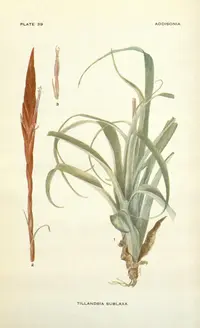
Leatherleaf airplant, Tillandsia variabilis, is a small epiphytic bromeliad that typically grows attached to tree branches rather than in soil. It forms loose rosettes of narrow, often slightly curling leaves that create a soft, textured clump.
In nature, it occurs from Mexico through Central America into parts of South America, usually in warm, humid forests with good air movement. Its ability to absorb water and nutrients through its leaves, combined with its modest size, makes it relatively straightforward to care for indoors.
Light, airflow, and regular moisture on the leaves are the main factors that influence how to care for leatherleaf airplant successfully.

Care Difficulty
Moderate Care

Light Preference
Partial Shade

Water Requirements
Moderate Water

Temperature Preference
Tropical / Frost Sensitive

Hardiness Zone
10–12

Soil Texture
Rocky, Organic-rich

Soil pH
Acidic (5.5–6.5)

Soil Drainage
Well-drained

Fertilization
Light (every 4–6 weeks)
Scan your plant to receive care tips personalized for your specific plant
Available on iOS and Android
This epiphytic species prefers bright, indirect light similar to bright forest canopy conditions.
This air plant absorbs moisture through its leaves and depends on thorough wetting followed by fast drying.
This species prefers warm, frost-free conditions similar to subtropical climates.
This epiphytic species benefits from moderately high humidity for steady growth.
Tillandsia variabilis does not need traditional soil and instead relies on air flow around its roots and leaf bases.
This air plant can grow in containers or mounted displays if excess moisture is controlled carefully.
Tillandsia variabilis benefits from light, diluted feeding during active growth but does not depend on heavy fertilization.
Pruning Tillandsia variabilis focuses on hygiene and tidying rather than reshaping the plant.
This epiphytic species is usually mounted rather than potted, so transplanting focuses on remounting rather than root disturbance.
Propagation of Tillandsia variabilis is most reliable through offsets, with seed used mainly for patient growers or breeding.
In mild climates this air plant tolerates cool conditions but is not frost hardy and needs protection in colder regions.

Plant Health Check
Not sure what's wrong with your plant? Check your plant's health inside the app.
This species shows strong leaf shape variation across its range, with plants from drier, more exposed sites forming shorter, stiffer leaves and those from wetter forests developing longer, softer foliage, which is why it was named variabilis.
In parts of its range, this air plant commonly grows as an epiphyte on oaks and other trees in open savanna-like habitats, tolerating higher light and more air movement than many related Tillandsia species.
During flowering, the bracts around the inflorescence can turn shades of purple, pink, or reddish, creating a strong contrast with the typically pale to bluish-violet petals.

Some botanists consider Tillandsia variabilis to form a complex of closely related, geographically varying populations, which has led to taxonomic debates about how many distinct species or varieties are actually involved.
Lack of bright, indirect light and insufficient maturity are common reasons this plant does not flower. It usually needs to be several years old and experience a slight seasonal temperature or daylength shift before blooming reliably.
Keep your plants happy and healthy with plant identification, disease detection, and easy care guidance.