Mark Dormant Clumps
Place discreet labels or stones where bulbs are planted so you avoid disturbing or slicing them when digging or replanting nearby beds after foliage dies back in summer.

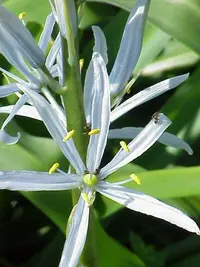
Cusick's camas, Camassia cusickii, is a bulb-forming perennial from the Pacific Northwest of the United States. It belongs to the asparagus family and grows from hardy underground bulbs that return each year. In spring, it sends up upright stems topped with star-shaped flowers in soft blue to lavender tones, above slender, grassy leaves. The clumps expand slowly, forming natural-looking drifts over time. This species comes from moist meadows and open slopes, so it prefers sun to light shade, cool conditions, and soil that stays evenly moist in spring but not waterlogged. Once established in a suitable site, it is relatively low-maintenance, which makes it easier to learn how to care for Cusick's camas outdoors in temperate climates.

Care Difficulty
Easy Care

Light Preference
Full Sun

Water Requirements
Regular Water

Temperature Preference
Cold Hardy

Hardiness Zone
4–8

Soil Texture
Loamy, Sandy, Organic-rich

Soil pH
Slightly acidic (6.5–7.0), Neutral (7.0)

Soil Drainage
Moist but well-drained

Fertilization
Minimal (feed rarely)
Scan your plant to receive care tips personalized for your specific plant
Available on iOS and Android
This bulb prefers bright conditions that mimic open meadows rather than deep woodland shade.
This species needs consistent moisture in spring but benefits from drier conditions once foliage begins to yellow.
This cold-hardy bulb is adapted to climates with cool, moist springs and relatively dry summers.
This bulb tolerates a wide humidity range, so indoor air is usually adequate.
Camassia cusickii prefers cool, moist, well-drained ground with a structured mineral base.
This species can be grown in containers if the pot is deep, stable, and drains very efficiently.
This bulb performs well in average garden soil but benefits from light feeding in poor or depleted ground.
Camassia cusickii needs minimal pruning, mainly to keep the planting tidy and support bulb health.
This bulb is usually grown in the ground and is moved only when clumps become crowded or flowering declines.
Camassia cusickii is commonly increased by bulb division, with seed used mainly for longer-term population building.
This hardy bulb tolerates typical winter conditions in much of the US and usually needs only basic soil protection.

Plant Health Check
Not sure what's wrong with your plant? Check your plant's health inside the app.
This species is naturally restricted to high-elevation meadows and open slopes of northeastern Oregon and adjacent Idaho, where it experiences cold, snowy winters and short, cool summers.
Its pale blue to bluish-white flowers have narrow, star-like tepals and a characteristic twisted appearance as they open, which helps distinguish it from other camas species with broader petals.
Unlike some other camas species that range widely across western North America, this plant has a relatively narrow native distribution, making its natural populations more sensitive to habitat disturbance and land-use change.

Bulbs of this species were historically eaten locally but were considered a secondary or emergency food compared with the more widely used and sweeter bulbs of common camas (Camassia quamash), which were preferred by Indigenous peoples of the region.
Lack of flowers often comes from insufficient winter chilling, overcrowded bulbs, planting too deep, or nutrient imbalance. Ensure bulbs experience a cool dormant period, divide congested clumps, and avoid high‑nitrogen fertilizer that favors leaves over blooms.
Keep your plants happy and healthy with plant identification, disease detection, and easy care guidance.