


Sturdy Stem Support
Install discreet ring stakes or low pea netting around the clump in late spring so tall, flower-heavy stems stay upright and do not snap in wind or rain.

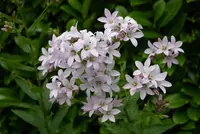
Milky bellflower, Campanula lactiflora, is a clump-forming perennial grown mainly for its airy clusters of starry, milky white to soft lavender blooms. It typically sends up tall, branching stems from a leafy base, creating a light, vertical accent in mixed borders and cottage-style plantings.
This species comes from the Caucasus region and nearby areas, where it grows in meadows and open woodland edges. Its upright habit and long flowering season make it useful for filling gaps among shrubs and other perennials.
Gardeners who want to care for Milky Bellflower will find it generally manageable if given moderate, consistent moisture, reasonably fertile, well-drained soil, and sun to light shade.

Care Difficulty
Moderate Care

Light Preference
Partial Sun

Water Requirements
Regular Water

Temperature Preference
Cold Hardy

Hardiness Zone
3–8

Soil Texture
Loamy, Silty, Organic-rich

Soil pH
Acidic (5.5–6.5), Slightly acidic (6.5–7.0)

Soil Drainage
Moist but well-drained

Fertilization
Light (every 4–6 weeks)
Scan your plant to receive care tips personalized for your specific plant
Available on iOS and Android
This perennial prefers bright conditions with some protection from intense midday sun.
This plant prefers evenly moist, well-drained soil rather than extremes of drought or saturation.
This species is a hardy perennial suited to cool to mild outdoor climates.
Humidity is rarely critical for Milky Bellflower if basic room conditions are stable.
Soil for Campanula lactiflora should be moderately fertile, well-drained, and slightly moist.
This species can grow successfully in containers when moisture and stability are carefully managed.
Campanula lactiflora benefits from light feeding during the active growing season in average garden soil.
Pruning Campanula lactiflora supports tidy growth and encourages prolonged flowering.
Milky bellflower is usually grown in the ground, so focus on dividing and transplanting rather than frequent repotting.
Campanula lactiflora is commonly propagated by division, seeds, or softwood cuttings.
Campanula lactiflora is generally cold hardy and needs only modest winter care in most temperate gardens.

Plant Health Check
Not sure what's wrong with your plant? Check your plant's health inside the app.
This species is naturally distributed in the Caucasus and parts of northern Turkey and Iran, where it grows in mountain meadows, forest margins, and open scrub on moist but well-drained soils.
The plant forms tall, branching stems topped with many starry, soft-mauve to white flowers whose slightly opaque, pale coloration gives rise to the common name milky bellflower.
Under suitable conditions, it can flower from early to late summer, often for 6–8 weeks, because new side shoots keep producing buds as older clusters fade.

Victorian and early 20th‑century European gardeners valued this species as a reliable filler for mixed borders, and many traditional cottage gardens used milky bellflower to create a vertical link between low perennials and taller shrubs due to its airy, see-through habit.
Sparse flowering usually comes from too much shade, nutrient-poor or very dry soil, or overcrowded clumps. Deadhead spent blooms, divide congested plants every few years, and ensure moderate feeding to support abundant flower production.
Keep your plants happy and healthy with plant identification, disease detection, and easy care guidance.

Snake orchid
Cymbidium suave

Adenophora morrisonensis
Adenophora morrisonensis

Hammerleaf Frangipani
Plumeria pudica

baneberry
Actaea simplex
calico aster
Symphyotrichum lateriflorum

Nettle-leaved Mullein
Verbascum chaixii 'Album'

Dicliptera peduncularis
Dicliptera peduncularis

Creeping jenny
Lysimachia nummularia