Post-bloom marking
As soon as the flowers fade, mark clumps with weatherproof labels so you can find the bulbs easily for future division or for avoiding damage during other planting or soil work.

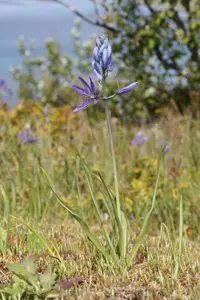
Small camas, Camassia quamash, is a bulb-forming perennial from the western regions of North America. It typically grows in meadows and open woodlands that hold moisture in spring. The plant produces upright clumps of narrow, grass-like leaves and tall flower stalks topped with star-shaped blue to violet blooms. These flowers create a striking vertical accent when planted in groups. Camassia quamash is relatively undemanding once established, as long as soil drains well and stays moist during its active growth. Understanding how to care for small camas starts with providing cool, moist springs and drier conditions after flowering.

Care Difficulty
Easy Care

Light Preference
Full Sun

Water Requirements
Moderate Water

Temperature Preference
Cold Hardy

Hardiness Zone
3–8

Soil Texture
Sandy, Loamy, Silty

Soil pH
Acidic (5.5–6.5), Slightly acidic (6.5–7.0)

Soil Drainage
Moist but well-drained

Fertilization
Minimal (feed rarely)
Scan your plant to receive care tips personalized for your specific plant
Available on iOS and Android
Camassia quamash grows best in open, bright sites that mimic sunny meadows.
Camassia quamash prefers steadily moist soil in spring, then drier conditions after flowering.
This bulb is cold-hardy and adapted to climates with cool, moist springs and dry summers.
Humidity is not a critical factor for Camassia quamash, which thrives in typical outdoor air conditions of 30–60%.
Camassia quamash prefers well-aerated, free-draining soil that stays moist in spring but does not remain waterlogged.
This species can be grown in containers if the pot is deep enough for its bulbs and drainage is carefully managed.
Camassia quamash grows well in average soil and usually needs only light feeding for reliable flowering.
Pruning needs for Camassia quamash are minimal and focus on tidiness rather than shaping.
This bulb is usually grown in the ground, so care centers on lifting and transplanting rather than frequent repotting.
Camassia quamash is commonly propagated by bulb division and by seed where slow naturalizing is acceptable.
This species is generally cold hardy in much of the US and needs little active winter care once established.

Plant Health Check
Not sure what's wrong with your plant? Check your plant's health inside the app.
This species produces loose spikes of star-shaped blue to violet flowers in late spring, each flower with six narrow tepals that often twist slightly as they age, giving the inflorescence a delicate, airy look.
Indigenous peoples of the Pacific Northwest, including many Salish and Nez Perce groups, traditionally harvested its bulbs as an important carbohydrate-rich food, carefully managing meadows with controlled burning and selective digging to maintain sustainable populations.
In the wild, this plant often grows near the highly toxic death camas (Toxicoscordion venenosum), and the bulbs can look similar, so traditional harvesters relied on the distinctive blue flowers and specific habitat patches to avoid accidental poisoning.

Genetic and field studies show that this species is a key component of remnant wet prairie and meadow ecosystems in the Pacific Northwest, where its dense spring flowering provides an important early-season nectar and pollen source for native solitary bees and early-emerging bumble bees before many other meadow plants bloom.
Lack of flowers often comes from insufficient winter chill, overcrowded bulbs, or nutrient imbalance from high-nitrogen fertilizer. Ensure bulbs experience cool winter conditions, space clumps every few years, and use a balanced, low-nitrogen product after flowering.
Keep your plants happy and healthy with plant identification, disease detection, and easy care guidance.