Support scrambling vines
Provide a sturdy trellis, mesh, or shrub framework early in the season so the long, brittle stems can climb and hang freely without kinking or breaking as they lengthen.

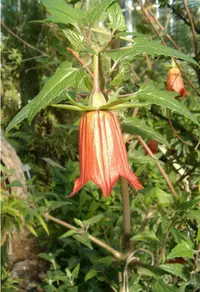
Canary bellflower, Canarina canariensis, is a tender perennial climber grown for its large, hanging, bell-shaped orange flowers and soft, trailing or twining stems. It usually behaves as a winter-growing, summer-dormant plant, dying back to underground tubers during rest.
This species is native to the Canary Islands, where it grows in cool, moist, partially shaded habitats such as laurel forests. In cultivation it prefers bright, filtered light, airy but moisture-retentive soil, and protection from frost.
Its seasonal dormancy and sensitivity to overwatering during rest make it moderately challenging, so it suits growers who are ready to learn how to care for Canary Bellflower.

Care Difficulty
Hard Care

Light Preference
Partial Shade

Water Requirements
Regular Water

Temperature Preference
Tropical / Frost Sensitive

Hardiness Zone
10–11

Soil Texture
Loamy, Sandy, Organic-rich

Soil pH
Acidic (5.5–6.5), Slightly acidic (6.5–7.0)

Soil Drainage
Moist but well-drained

Fertilization
Light (every 4–6 weeks)
Scan your plant to receive care tips personalized for your specific plant
Available on iOS and Android
This scrambling tuberous perennial prefers bright, gentle light that mimics its native laurel forest edges.
This species needs steadily moist but air-filled soil during active growth, then much drier conditions in dormancy.
This Canary Island climber grows best with mild, frost-free conditions and cool-season growth.
This species benefits from moderately humid air, especially during active growth.
This tuberous climber needs loose, sharply drained yet moisture-retentive soil to avoid rot.
This species is well suited to container growing, especially in cooler climates or where winter protection is needed.
This tuberous climber benefits from moderate feeding during its active growth period for reliable flowering.
Pruning Canarina canariensis focuses on tidying growth and maintaining a manageable framework for flowering.
Container-grown plants benefit from occasional repotting to refresh the soil and manage the tuber size.
This species is most often propagated by seed or careful division of mature tubers.
Canarina canariensis is frost sensitive and needs protection in regions with cold winters.

Plant Health Check
Not sure what's wrong with your plant? Check your plant's health inside the app.
This species is native to the humid laurel forests of the Canary Islands, where it naturally grows as a scrambling understory plant, often climbing over shrubs rather than standing upright on its own.
Unlike many ornamentals, it grows actively in cool, moist winter conditions and then dies back completely to its underground tuber in summer, entering a true dry-season dormancy.
The large orange bells are mainly pollinated by birds and insects capable of vibrating the flowers, which helps release pollen from the anthers in a process similar to buzz pollination known from some tomatoes.

In its native Canary Islands, this species is considered a Tertiary relict, meaning it is a surviving member of an ancient flora that once covered much larger areas of the Mediterranean region but now persists only in a few isolated refuges.
It can be grown indoors if given strong light, cool winter rest, and support for its trailing stems. Good drainage and moderate humidity are important. Consistent conditions are the basis of reliable Canary Bellflower indoor care.
Keep your plants happy and healthy with plant identification, disease detection, and easy care guidance.