


Select stable substrate
Choose long-lasting, low-nutrient rocks such as siliceous sandstone, basalt, or old concrete with a rough surface, since this crustose lichen anchors to the substrate and does not transplant well from one surface to another.

Candelariella medians is a small crustose lichen, not a traditional leafy plant. It forms thin, flat, yellow to yellow-green patches tightly attached to rock or bark. The surface often looks granular or finely textured, with tiny disc-like fruiting bodies that hold its reproductive spores.
This species is typically found in temperate regions on exposed, nutrient-poor substrates, especially siliceous rocks and sometimes tree bark. It is slow-growing but quite resilient, tolerating strong light, wind, and periods of dryness.
Because it is specialized for natural outdoor habitats, it is not suited to typical houseplant conditions, and how to care for Candelariella medians indoors is not well established.

Care Difficulty
Moderate Care

Light Preference
Partial Sun

Water Requirements
Low Water

Temperature Preference
Cool Climate

Hardiness Zone
Unknown

Soil Texture
Rocky, Sandy

Soil pH
Slightly acidic (6.5–7.0)

Soil Drainage
Well-drained

Fertilization
Minimal (feed rarely)
Scan your plant to receive care tips personalized for your specific plant
Available on iOS and Android
This crustose lichen prefers bright, open conditions but adapts to some shade on exposed rocks or bark.
This lichen absorbs water from rain, fog, and surface moisture, so active watering is rarely needed in natural settings.
This species is adapted to outdoor temperature swings but has clear limits for long-term survival.
This crustose lichen tolerates a wide humidity range but benefits from moderately moist air.
This lichen naturally colonizes mineral substrates and does not require conventional potting soil, but similar conditions can be simulated on inert media.
This species is only loosely suitable for container growing and is best treated as an experimental or educational lichen project rather than a standard potted plant.
This crustose lichen normally grows on nutrient-poor bark or rock and does not need intentional fertilizing in cultivation or in situ.
As a crustose lichen, Candelariella medians does not require pruning and should generally be left undisturbed on its natural substrate.
This species naturally colonizes bark, rock, or other hard surfaces and is not suited to routine repotting like a potted plant.
Propagation of this lichen is specialized and rarely attempted outside research or conservation work, so hobbyist-level propagation is not recommended.
This lichen is generally cold hardy in its native range and does not need dedicated winter care in outdoor conditions.

Plant Health Check
Not sure what's wrong with your plant? Check your plant's health inside the app.
This species is a lichen, not a moss or fungus, formed by a partnership between a fungus and microscopic algae that live together as a single organism on rock surfaces.
It grows mainly on calcareous rocks such as limestone and mortar, where it forms small, bright yellow areoles that often create patchy crusts on walls, boulders, and exposed outcrops.
Under a microscope it can be distinguished from similar yellow crust lichens by its characteristic spore shape and septation, which lichenologists use as a key diagnostic feature in identification.
This lichen maintains its thallus all year, so it functions as an evergreen organism. Color intensity can shift with moisture and light, appearing brighter when hydrated and duller or slightly paler during dry periods.
Keep your plants happy and healthy with plant identification, disease detection, and easy care guidance.

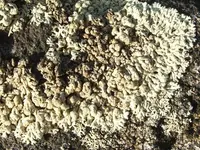
arctoparmelia lichen
Arctoparmelia incurva
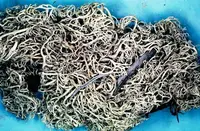
Reindeer Lichen
Cladonia arbuscula
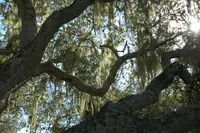
Lace lichen
Ramalina menziesii
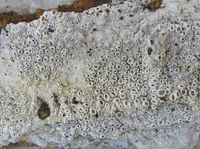
Bark barnacles
Thelotrema lepadinum
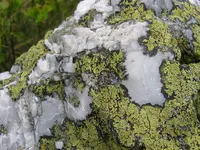
world map lichen
Rhizocarpon geographicum
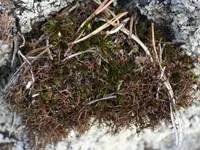
Dubious Heath Lichen
Cetraria muricata
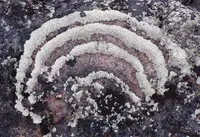
arctoparmelia lichen
Arctoparmelia centrifuga
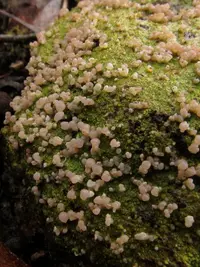
Baeomyces heteromorphus
Baeomyces heteromorphus