Salt-tolerant siting
Use this shrub as a windbreak or screening plant in coastal gardens, placing it on the seaward side of more sensitive species to exploit its natural tolerance of salt spray while protecting less hardy plants behind it.

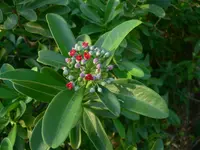
Wild cinnamon (Canella winterana) is an evergreen shrub or small tree from the Caribbean and nearby coastal regions of Florida and Central America. It is not related to true cinnamon but has aromatic bark and leaves with a spicy scent when crushed.
Plants have dense, glossy foliage and small white to pinkish flowers that are followed by attractive red berries, giving it ornamental value in warm climates. Growth is naturally upright and compact, which can suit larger containers or sheltered gardens.
It prefers bright light, warm temperatures, and well-drained, slightly sandy soil, which reflects its coastal origin. These traits make it moderately easy to grow if you understand how to care for wild cinnamon in similar conditions.

Care Difficulty
Moderate Care

Light Preference
Partial Sun

Water Requirements
Moderate Water

Temperature Preference
Tropical / Frost Sensitive

Hardiness Zone
10–11

Soil Texture
Sandy, Loamy, Organic-rich

Soil pH
Acidic (5.5–6.5), Slightly acidic (6.5–7.0)

Soil Drainage
Moist but well-drained

Fertilization
Minimal (feed rarely)
Scan your plant to receive care tips personalized for your specific plant
Available on iOS and Android
This evergreen shrub prefers bright, warm conditions similar to its native coastal habitats.
This species prefers evenly moist, well‑drained soil and does not tolerate prolonged flooding.
This tropical shrub thrives in consistently warm, frost‑free conditions.
This species prefers moderately humid air but adapts to many home conditions.
Canella winterana grows best in loose, well-drained, slightly acidic to neutral substrate.
This shrub can be grown in containers if the pot is chosen to support its deep, woody root system.
Canella winterana responds to modest feeding but does not require heavy fertilization for healthy growth.
Pruning Canella winterana is mainly done to maintain structure and remove problem wood rather than to control size aggressively.
This species is most often grown in the ground, so care focuses on thoughtful transplanting rather than frequent repotting.
Propagation of Canella winterana is possible but slow, and is most practical for patient growers or conservation plantings.
This subtropical tree is not reliably frost hardy and benefits from targeted winter protection in cooler regions.

Plant Health Check
Not sure what's wrong with your plant? Check your plant's health inside the app.
This evergreen shrub or small tree is native to coastal areas of the Caribbean and parts of Florida, where it often grows on sandy, limestone-based soils and tolerates salt-laden winds better than many broadleaf species.
The inner bark has a warm, aromatic scent and taste reminiscent of true cinnamon, although Canella winterana is not closely related to Cinnamomum species and belongs to its own small family, Canellaceae.
Its bright red berries are a food source for several bird species in its native range, and the dense, finely branched crown offers shelter and nesting sites in coastal thickets.

The name winterana comes from the historical genus name Wintera, chosen in honor of Captain William Winter, who collected aromatic plants during early voyages that expanded European knowledge of tropical flora.
Growth is moderate, usually 15–30 cm per year in warm conditions. Expect a small, usable shrub in 3–5 years and near-mature size in 8–12 years, depending on light, soil quality, and moisture consistency.
Keep your plants happy and healthy with plant identification, disease detection, and easy care guidance.