


Host tree selection
Establish this fungus in mossy, undisturbed turf or light conifer litter under pines or mixed woodland trees, as it fruits most reliably where needles and fine roots create a stable, cool microhabitat.

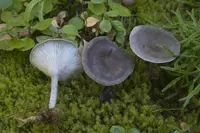
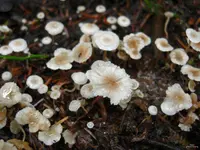
The Humpback, Cantharellula umbonata, is a small, hump-capped mushroom rather than a leafy houseplant. It forms clusters of slender, pale to grayish fruiting bodies with a distinct central bump on the cap. In nature it appears in cool, moist coniferous forests, often among mosses and acidic soils.
This fungus has a fairly specific habitat and is not commonly cultivated indoors, so it suits enthusiasts more than beginners. Those who want to care for The Humpback need to understand basic mushroom needs such as steady moisture, cool temperatures, and consistently organic, well-drained substrate.

Care Difficulty
Moderate Care

Light Preference
Partial Shade

Water Requirements
Keep Soil Moist

Temperature Preference
Cool Climate

Hardiness Zone
Unknown

Soil Texture
Loamy, Silty, Organic-rich

Soil pH
Strongly acidic (4.5–5.5), Acidic (5.5–6.5)

Soil Drainage
Moist but well-drained

Fertilization
Minimal (feed rarely)
Scan your plant to receive care tips personalized for your specific plant
Available on iOS and Android
This fungus prefers cool forest light rather than strong direct sun.
Moist, never waterlogged, conditions are essential for steady fruiting.
Stable cool to mild temperatures support reliable development of this forest fungus.
This fungus prefers moderately moist air but is not highly humidity-sensitive in outdoor conditions.
Cantharellula umbonata develops best in loose, organic-rich substrates that mimic forest litter over mineral soil.
This species is generally unsuitable for typical ornamental container growing, since it relies on complex outdoor soil and litter conditions.
Cantharellula umbonata is a wild, mycorrhizal fungus that generally performs best without added fertilizer in natural soil.
Pruning is not a standard practice for Cantharellula umbonata, because the visible mushrooms are short-lived fruiting bodies rather than permanent plant structures.
Transplanting this woodland fungus is unreliable, as Cantharellula umbonata depends on specific soil fungi and host roots in situ.
Propagation of Cantharellula umbonata in home settings is challenging and rarely attempted successfully.
This species is naturally cold hardy in its native range and usually needs no special winter care in the ground.

Plant Health Check
Not sure what's wrong with your plant? Check your plant's health inside the app.
This small grayish mushroom often fruits directly among mosses, especially in moist coniferous forests, and is frequently seen forming loose groups emerging through dense moss carpets.
Mature fruiting bodies develop a noticeable central bump, or umbo, on the cap, which helps separate it from many similar pale, thin-fleshed mushrooms in the field.
The flesh is thin, pale, and can have a mild, sometimes slightly farinaceous (mealy) odor, a trait mycologists use along with gill structure and habitat to confirm identification.
This fungus is generally classified as inedible. It is not known to be a desirable culinary mushroom and may be confused with other small grey species. For safety, it should not be collected or eaten.
Keep your plants happy and healthy with plant identification, disease detection, and easy care guidance.

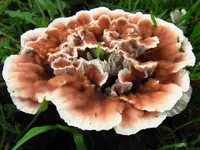
Blushing Rosette
Abortiporus biennis
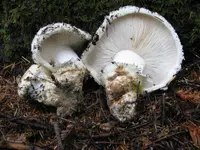
American matsutake
Tricholoma magnivelare
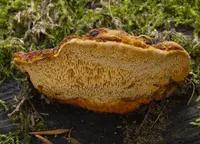
Anise Mazegill
Gloeophyllum odoratum
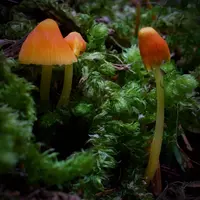
tangerine bonnet
Atheniella aurantiidisca
Cerioporus mollis
Cerioporus mollis
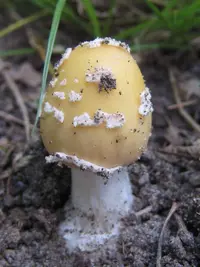
Great Funnel-Veil Amanita
Amanita velatipes
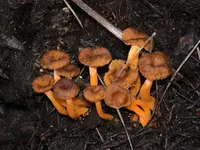
Cantharellus xanthopus
Cantharellus lutescens
Piggyback Shanklet
Collybia cirrhata