California Golden Chanterelle Care (Cantharellus californicus)

California Golden Chanterelle

About California Golden Chanterelle

The California golden chanterelle, Cantharellus californicus, is a large, mycorrhizal mushroom that forms a partnership with the roots of native trees. It is not a typical houseplant but a forest-dwelling fungus.

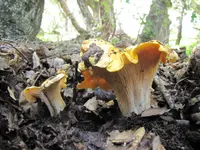
Fruiting bodies are yellow to golden, with wavy caps and thick, blunt ridges instead of sharp gills, usually appearing in clusters on the ground. This species is native to California woodlands, especially under oaks, where it emerges seasonally from undisturbed soil and leaf litter.

Because it depends on a living tree host, it is challenging to cultivate and difficult for beginners to care for California Golden Chanterelle at home. It generally prefers moist, well-drained, organically rich soils and stable, mild woodland conditions.

Main Plant Requirements

Care Difficulty

Hard Care

Light Preference

Partial Shade

Water Requirements

Keep Soil Moist

Temperature Preference

Warm Climate

Hardiness Zone

8–10

Soil Texture

Loamy, Organic-rich

Soil pH

Acidic (5.5–6.5)

Soil Drainage

Moist but well-drained

Fertilization

Minimal (feed rarely)

Get Personalized Care Plan

Scan your plant to receive care tips personalized for your specific plant

Available on iOS and Android

How to Care for the California Golden Chanterelle

This ectomycorrhizal fungus prefers dappled woodland light rather than open sun.

  • Provide bright shade or filtered light under oaks or other broadleaf trees, with about 2–4 hours of gentle morning sun and full shade in the hot afternoon.
  • Avoid direct midday sun, which can overheat the soil surface, dry leaf litter, and suppress California Golden Chanterelle fruiting bodies.
  • In summer, maintain deeper shade or thicker mulch; in cooler months, slightly more open canopy is acceptable if soil stays cool and moist.

This woodland fungus depends on consistently moist, not saturated, soil around its host tree roots.

  • Aim for evenly moist top 5–10 cm of soil and leaf litter; it should feel cool and slightly damp but not muddy when pressed.
  • Increase moisture through occasional deep soaking or irrigation during dry seasons, then allow surface to drain fully to avoid standing water and root-zone suffocation.
  • Reduce supplemental watering in cool, rainy seasons; signs of excess moisture include sour odors and slimy litter, while dull, brittle leaf litter indicates underwatering stress for Cantharellus californicus.

This species fruits best in mild, maritime-influenced climates with cool, moist soil.

  • Optimal fruiting and mycelial activity typically occur around 50–65°F (10–18°C), especially after autumn and winter rains when soils remain cool.
  • The fungus tolerates brief drops near 30–32°F (-1–0°C) in soil, but repeated hard frosts or frozen ground can reduce fruiting and damage fine mycelial threads.
  • Sustained heat above 80°F (27°C) with dry soil strongly suppresses growth; maintain shade, mulch, and soil moisture through hot, dry seasons to buffer temperature swings.

This ectomycorrhizal mushroom requires consistently moist, humid conditions around the soil surface to fruit well.

  • Aim for 70–90% ambient humidity around the fruiting area, with the substrate staying evenly moist but never waterlogged.
  • Dry air causes caps to crack, edges to curl, and primordia (tiny baby mushrooms) to abort before developing.
  • Increase humidity by using a fine mist over the surrounding leaf litter, adding damp (not wet) mulch, or using a shaded, wind-sheltered site.

This fungus fruits best in loose, organic-rich soil that mimics a natural oak woodland floor.

  • Use a deep layer of crumbly, well-aerated loam rich in leaf litter, small wood chips, and fully decomposed compost to support the host tree roots.
  • Ensure rapid drainage so water never pools; soil should feel moist yet free-draining, breaking apart easily rather than forming clumps.
  • Maintain a slightly acidic to neutral pH around 5.5–7.0, which supports both Cantharellus californicus and its associated tree partners.
  • Improve aeration and structure by incorporating coarse bark fines and small amounts of sharp sand while avoiding dense clay, peat-heavy, or compacted substrates.

This species is not realistically suitable for container growing because it needs a stable, long-term partnership with mature tree roots in undisturbed soil.

This ectomycorrhizal fungus relies on its tree partners for nutrients, so the California Golden Chanterelle usually needs no direct fertilization.

Pruning is not applicable to Cantharellus californicus, since it is a wild mushroom forming fruiting bodies from an underground mycelial network.

Transplanting Cantharellus californicus is rarely successful because it depends on a stable symbiosis with specific tree roots and soil fungi.

  • Leave existing colonies undisturbed; avoid digging or soil removal around host tree drip lines.
  • If relocation is attempted for research, move intact soil monoliths, keeping root systems and mycelium undisturbed.
  • Plan any move during cool, moist seasons to reduce stress and desiccation of roots and fungal tissue.
  • Maintain original soil orientation and depth to preserve microclimate and mycorrhizal contact.

Practical propagation of Cantharellus californicus is difficult and not reliable for home growers, so deliberate methods are rarely used.

This species is generally adapted to the mild, wet winters of its native range and needs no specific winter care in natural settings.

Care Tips

Host tree selection

Establish new patches near compatible host trees such as coast live oak or tanoak, since this mycorrhizal mushroom depends on forming a root partnership and will not fruit reliably without a suitable tree partner.

Minimal soil disturbance

Mark productive areas and avoid digging, raking, or compacting the soil within 1–2 m of host tree trunks so the fine mycorrhizal network in the upper soil layer remains intact and able to fruit each season.

Leaf litter management

Maintain a loose, natural layer of leaf litter and small twigs over the fruiting zone, only removing heavy mats or thick wood chips, because a thin organic layer helps regulate moisture while still allowing mushrooms to emerge.

Seasonal moisture timing

If supplemental irrigation is legal and appropriate, apply deep, infrequent water in late summer to early fall around host trees to mimic the first autumn rains, which can help trigger more consistent flushes when trying to grow Cantharellus californicus.

Harvesting technique

Cut mushrooms at the base with a clean knife instead of pulling them out, and gently replace disturbed litter, which reduces damage to the underground mycelium and supports long-term sustainability when caring for California Golden Chanterelle.

Common Pests and Diseases

Mycophagous slugs

This pest feeds on developing mushroom primordia and mature chanterelle caps, often leaving large irregular holes and slime trails. Symptoms include missing flushes, ragged cap edges, and damaged gill-like ridges.

Solution

Hand-pick slugs at dusk or early morning, use beer or yeast traps, and place copper tape or sharp grit barriers around high-value fruiting zones. Reduce dense groundcover that shelters slugs, and if needed use iron phosphate slug pellets labeled for edible mushrooms, following label directions carefully.

Fungus gnat larvae

These insects may tunnel through young fruiting bodies and mycelial mats, leading to distorted, water-soaked, or partially collapsed chanterelles. Symptoms include tiny entry holes, softening tissue, and small black adult gnats hovering near fruiting sites.

Solution

Improve surface drainage and avoid chronically saturated soil, then use yellow sticky cards to reduce adult gnats. Where cultivation is attempted, cover fruiting areas with fine insect mesh during peak gnat activity and, if permitted for the site, apply a Bacillus thuringiensis israelensis (BTI) product to target larvae in the upper soil layer.

Bacterial blotch

This disease causes irregular, water-soaked spots that turn tan to brown on the mushroom surface, especially during warm, wet periods. Symptoms include sticky or greasy patches and rapid loss of market quality.

Solution

Limit overhead wetting by avoiding unnecessary irrigation directly over fruiting bodies and harvest during drier weather when possible. Improve airflow at the forest floor by thinning dense leaf litter in small patches and promptly remove and discard affected chanterelles away from the fruiting zone to reduce bacterial load.

Moldy fruiting bodies

This disease involves opportunistic molds colonizing overmature or damaged chanterelles, producing white, gray, or green fuzzy growth on caps and folds. Symptoms include soft, decomposing tissue and off-odors that quickly spread through a cluster.

Solution

Harvest chanterelles promptly at the correct maturity stage and avoid leaving damaged mushrooms in place, as they become inoculum sources. Increase spacing when collecting by not trampling the surrounding litter, and avoid covering stored harvests in airtight containers while still moist to reduce mold development during storage.

Interesting Facts

Largest chanterelle species

This species forms some of the largest chanterelle fruiting bodies known, with caps that can reach well over 20 cm across in mature specimens under favorable conditions.

California oak specialist

It forms mycorrhizal partnerships with several native California oaks, especially coast live oak and tanoak, exchanging mineral nutrients for sugars from the tree roots.

Extended fruiting lifespan

Individual fruiting bodies can persist and continue growing for several weeks, sometimes developing layered growth zones that show their prolonged development on the forest floor.

Botan icon

Did you know?

Genetic studies indicate that what appears to be a single huge mushroom in this species can actually be a single clonal individual that fruits in the same general area year after year, reflecting a long-lived underground mycelial network associated with its host trees.

FAQs about California Golden Chanterelle

This species is a highly regarded edible mushroom when correctly identified. It has firm, meaty flesh, fruity aroma, and good flavor when cooked. Misidentification with toxic look-alikes is a serious risk, so expert confirmation is essential.

Grow Healthy Plants with Botan Care

Keep your plants happy and healthy with plant identification, disease detection, and easy care guidance.

Botan plant care app — identify plants on mobile

Explore More Plants