


Host tree selection
Establish the fungus near compatible conifers such as Douglas-fir, hemlock, or spruce from local genetic stock, since the mycorrhizal association is highly host-specific and imports from distant regions adapt poorly.

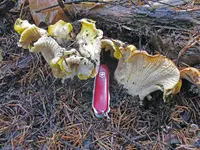
Cascade chanterelle, Cantharellus cascadensis, is a wild, mycorrhizal fungus that forms partnerships with tree roots rather than growing like a typical garden plant. It produces firm, yellow to orange, funnel-shaped fruiting bodies with blunt ridges instead of true gills, usually appearing in mossy forest floors.
This species is native to the Pacific Northwest of North America, especially in moist coniferous forests at higher elevations. It is considered a desirable edible mushroom but is challenging to cultivate, since it depends on specific tree hosts and stable forest conditions.
For those interested in how to care for Cascade chanterelle, the most realistic approach is to support healthy, undisturbed forest-like conditions with suitable host trees and consistently moist, well-drained soil rich in organic matter.

Care Difficulty
Hard Care

Light Preference
Partial Shade

Water Requirements
Keep Soil Moist

Temperature Preference
Cool Climate

Hardiness Zone
6–9

Soil Texture
Loamy, Sandy, Organic-rich

Soil pH
Strongly acidic (4.5–5.5), Acidic (5.5–6.5)

Soil Drainage
Moist but well-drained

Fertilization
Minimal (feed rarely)
Scan your plant to receive care tips personalized for your specific plant
Available on iOS and Android
This forest-dwelling fungus prefers cool, stable light conditions rather than direct, intense sun.
This mycorrhizal fungus depends on consistently moist, not saturated, soil around its tree partners.
This species fruits best in cool to mild conditions typical of coastal and montane forests.
This mycorrhizal fungus requires consistently moist, cool air to fruit reliably outdoors.
This species depends on native forest soil and cannot be sustained in artificial mixes.
This forest mushroom is not suitable for true container cultivation, as it requires a stable mycorrhizal relationship with host tree roots in the ground.
This woodland mushroom forms nutrient-sharing mycorrhizae with host trees, so Cantharellus cascadensis usually needs no direct fertilization.
Pruning is not applicable to Cantharellus cascadensis, as it is a wild mycorrhizal mushroom rather than a conventional garden plant.
Transplanting this forest-dwelling chanterelle is rarely successful because it depends on a stable mycorrhizal partnership with established trees.
Propagation of Cantharellus cascadensis is complex and usually left to natural spore dispersal and mycorrhizal spread in suitable forests.
This native chanterelle is cold hardy in its natural range and generally needs no special winter care when left in place.

Plant Health Check
Not sure what's wrong with your plant? Check your plant's health inside the app.
This species is native to the Pacific Northwest of North America, where it fruits in cool, moist conifer forests, especially under Douglas-fir and other native conifers on well-drained, often volcanic soils.
Unlike some yellow chanterelle relatives, this species has a bright yellow to orange exterior but distinctly whitish interior flesh and false gills, which helps mycologists separate it from similar golden chanterelles in the field.
Although long collected as a chanterelle in the region, it was only described and separated as its own species in the early 2000s based on detailed morphological and ecological study.

This mushroom forms an obligate ectomycorrhizal partnership with its host trees, creating a mutualistic association on the roots that helps the trees absorb water and mineral nutrients while the fungus receives sugars produced by photosynthesis.
This species is considered an edible wild mushroom when correctly identified, with firm flesh and a fruity aroma. However, it has look‑alikes, so only forage with expert confirmation or buy from reputable local mushroom specialists.
Keep your plants happy and healthy with plant identification, disease detection, and easy care guidance.

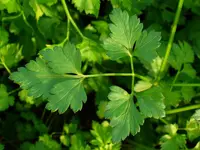
parsley
Petroselinum crispum
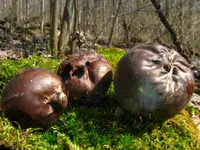
Tumbling puffball
Bovista pila
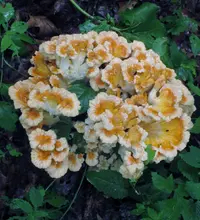
White-pored Chicken of the Woods
Laetiporus cincinnatus
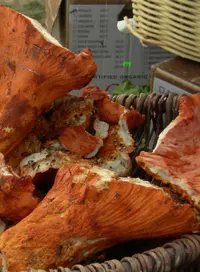
lobster mushroom
Hypomyces lactifluorum
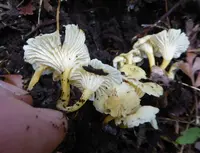
Cantharellus wellingtonensis
Cantharellus wellingtonensis
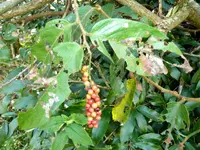
tasselberry
Antidesma venosum
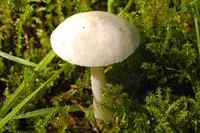
bearded dapperling
Cystolepiota seminuda
black highbush blueberry
Vaccinium fuscatum