Controlled root restriction
Use a slightly undersized, wide container or a root-pruning air-pot to keep the root system mildly constrained, which encourages earlier and heavier flowering when growing caper bush.

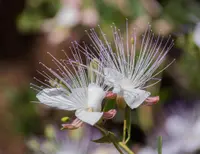
Caper bush (Capparis spinosa) is a small, woody shrub known for its rounded flower buds, which are harvested as capers. It has arching, spiny branches and small, rounded leaves, often forming a low, mounded shape.
This plant is native to dry, rocky areas around the Mediterranean and parts of Asia, where it thrives in heat, sun, and poor, well-drained soils. It is drought-tolerant and long-lived but can be slow to establish, so patience is important when learning how to care for caper bush.
In suitable warm climates it is generally low-maintenance, provided it receives strong light, good drainage, and protection from prolonged cold or waterlogging.

Care Difficulty
Moderate Care

Light Preference
Full Sun

Water Requirements
Low Water

Temperature Preference
Warm Climate

Hardiness Zone
8–11

Soil Texture
Sandy, Loamy, Rocky

Soil pH
Neutral (7.0), Slightly alkaline (7.0–7.5)

Soil Drainage
Well-drained

Fertilization
Minimal (feed rarely)
Scan your plant to receive care tips personalized for your specific plant
Available on iOS and Android
This sun-loving shrub thrives in bright, exposed sites with long daily light periods.
This drought-tolerant shrub prefers infrequent, deep watering in fast-draining soil.
This Mediterranean shrub prefers hot, dry summers and mild, frost-free winters.
Humidity is rarely a limiting factor for caper bush in typical home or outdoor conditions.
Capparis spinosa prefers very well-aerated, fast-draining, low-fertility mineral soil.
This species is well-suited to container growing in sunny, dry locations.
This drought-adapted shrub needs only light feeding, especially in poor soils.
Thoughtful pruning supports a compact shape and good flowering in Capparis spinosa.
This deep-rooted shrub is usually grown in the ground, so focus on careful transplanting rather than frequent repotting.
Reproduction of Capparis spinosa is possible by both seeds and semi-hardwood cuttings, but patience is required.
Mature plants tolerate brief light frost but young Capparis spinosa benefit from simple winter protection in cold climates.

Plant Health Check
Not sure what's wrong with your plant? Check your plant's health inside the app.
This shrub often grows in coastal and rocky habitats and shows clear halophytic behavior, meaning it tolerates salty soils that stress many other species.
The familiar pickled capers used in cooking are the unopened flower buds of this species, harvested while still tight and then cured to develop their characteristic pungent, mustard-like flavor.
In the Mediterranean region it is known for colonizing vertical walls and rocky crevices, where its deep, widely spreading root system anchors the plant and helps stabilize loose substrates.

Genetic and archaeological evidence links this species with very ancient human use in the Mediterranean and Near East, with carbonized seeds and remains found at several Neolithic and Bronze Age sites, indicating it has been gathered and possibly managed by people for thousands of years.
Poor flowering usually comes from insufficient heat, too little direct sun, or overfeeding with high-nitrogen fertilizer. Ensure long, hot summers, lean mineral soil, and avoid heavy pruning of young shoots where flower buds are formed.
Keep your plants happy and healthy with plant identification, disease detection, and easy care guidance.