Clump Renewal
Every 3–4 years, lift and divide congested clumps in early spring, replanting only the younger vigorous outer sections and discarding the woody centers to maintain dense, uniform growth.

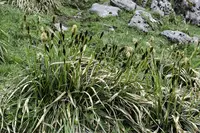
Carex brevicollis is a small, tuft-forming sedge with fine, arching leaves that create low, dense clumps. It has a grass-like look but belongs to a different plant group. This species occurs naturally in montane and subalpine meadows and open slopes across parts of Europe, often on calcareous or rocky soils.
The plant is generally hardy and long-lived if given conditions similar to its native habitat. It tolerates cool temperatures, relatively poor soils, and moderate moisture, which makes it straightforward to care for Carex brevicollis in suitable outdoor settings.

Care Difficulty
Moderate Care

Light Preference
Partial Shade

Water Requirements
Moderate Water

Temperature Preference
Cold Hardy

Hardiness Zone
4–8

Soil Texture
Loamy, Sandy, Organic-rich

Soil pH
Acidic (5.5–6.5), Slightly acidic (6.5–7.0)

Soil Drainage
Moist but well-drained

Fertilization
Minimal (feed rarely)
Scan your plant to receive care tips personalized for your specific plant
Available on iOS and Android
This cool-season sedge prefers bright, gentle outdoor light that avoids intense summer heat.
This grass-like perennial prefers consistently moist but not waterlogged soil.
This hardy sedge tolerates cool conditions and moderate heat when soil moisture is stable.
This grasslike species tolerates a broad humidity range and usually does not need special humidity control indoors or outdoors.
This species prefers moderately fertile, well-draining soil that stays lightly moist but never waterlogged.
This sedge adapts well to container growing outdoors when given stable moisture and reliable drainage.
This grass is modest in its nutrient needs, so focus on light feeding rather than heavy fertilization.
Pruning is simple and mainly keeps the plant tidy and encourages fresh foliage.
This sedge is most often grown in the ground; transplanting is only needed when clumps outgrow their space or soil conditions decline.
Division is the standard method for increasing plants while keeping the same foliage characteristics.
This species is generally cold hardy in temperate climates and needs only modest winter attention.

Plant Health Check
Not sure what's wrong with your plant? Check your plant's health inside the app.
This sedge occurs mainly in subalpine and alpine grasslands of central and southern Europe, often above the tree line where conditions are cool, windy, and nutrient-poor.
Populations are especially frequent on calcareous soils derived from limestone or dolomite, where the slightly alkaline reaction and mineral composition favor its growth.
It forms part of high-mountain pastures used by wild herbivores and livestock, contributing to turf stability and providing moderate forage in short, dense swards.
This sedge forms compact, slowly expanding clumps rather than running aggressively. It can broaden over time through short rhizomes, but in typical garden conditions it is considered well-behaved and usually does not require containment edging.
Keep your plants happy and healthy with plant identification, disease detection, and easy care guidance.