Windbreak establishment
In open, windy sites, install a porous windbreak such as shade cloth or a slatted fence on the windward side to reduce branch breakage and fruit drop while the shrub is still young.

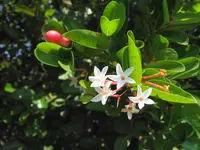
Karanda, Carissa carandas, is a dense, thorny evergreen shrub or small tree grown for its glossy leaves, white star-shaped flowers, and tart berry-like fruits. It often forms a compact, branching hedge and can be kept pruned for ornamental or edible landscaping uses.
This species is native to India and other parts of South and Southeast Asia, where it tolerates heat, sun, and seasonal dry periods. Its drought tolerance and tough structure make it relatively resilient once established, though young plants need consistent moisture and well-drained soil. Understanding how to care for karanda starts with providing bright light and avoiding waterlogged conditions.

Care Difficulty
Moderate Care

Light Preference
Full Sun

Water Requirements
Moderate Water

Temperature Preference
Tropical / Frost Sensitive

Hardiness Zone
10–11

Soil Texture
Sandy, Loamy, Organic-rich

Soil pH
Acidic (5.5–6.5), Slightly acidic (6.5–7.0)

Soil Drainage
Well-drained

Fertilization
Light (every 4–6 weeks)
Scan your plant to receive care tips personalized for your specific plant
Available on iOS and Android
This thorny evergreen shrub thrives in strong light and warmth for best flowering and fruiting.
Carissa carandas prefers slightly dry conditions over constant moisture once established.
This subtropical shrub grows best in warm, frost-free climates with stable temperatures.
Carissa carandas handles a wide humidity range but grows best in moderately dry to slightly humid air.
Carissa carandas prefers well‑aerated, fast‑draining soil that still holds moderate moisture.
This species is well suited to container cultivation, including use as a patio shrub or compact hedge.
Carissa carandas responds well to moderate feeding in warm months but tolerates lean soil once established.
Pruning Carissa carandas helps maintain a compact, productive shrub and improves light penetration.
Carissa carandas is usually grown as a landscape shrub, so transplanting timing and method matter more than frequent repotting.
Carissa carandas is commonly propagated from semi-hardwood cuttings or seed, depending on the desired uniformity of plants.
Carissa carandas is frost-sensitive and needs protection in regions with cold winters.

Plant Health Check
Not sure what's wrong with your plant? Check your plant's health inside the app.
The fruits are eaten both unripe and ripe by many bird species in South Asia, which helps disperse Carissa carandas seeds across open scrub and dry forest edges where few other shrubs can establish.
This species develops rigid, forked spines at the nodes, and in its native range it has long been planted as a living fence to deter livestock and human intruders without the need for wire or boards.
C. carandas naturally occurs in hot, seasonally dry, and sometimes saline sites, showing notable tolerance to both drought and moderate soil salinity compared with many other fruiting shrubs.

In parts of India and neighboring regions, large-scale traditional pickling and preserving industries are based specifically on the sour, unripe fruits of Carissa carandas, making it an important minor fruit crop that supports local economies rather than just a home-garden plant.
The fruits are edible when fully ripe and are widely used in jams, pickles, chutneys, and beverages. Unripe fruits are very sour and astringent, so they are usually cooked or preserved rather than eaten fresh.
Keep your plants happy and healthy with plant identification, disease detection, and easy care guidance.