Control Spreading Edges
Periodically lift and cut back outer stems that root along the ground to prevent the mat from smothering nearby plants and to keep paths and hardscape clear.

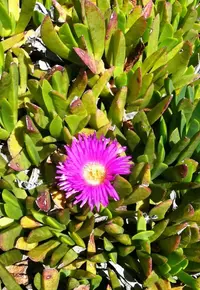
Mountain sourfig, Carpobrotus mellei, is a creeping, mat-forming succulent commonly used as a groundcover in mild coastal climates. It belongs to the ice plant group and stores water in thick, triangular leaves.
The plant produces bright, daisy-like flowers followed by edible, fig-like fruits with a tangy flavor. Its dense growth helps stabilize sandy soils and slopes.
Carpobrotus mellei is native to coastal areas of South Africa, where it thrives in sandy, well-drained soils and full sun with dry to moderate moisture. These natural adaptations make it relatively easy to care for Mountain Sourfig in similar conditions, especially in low-maintenance, drought-tolerant plantings.

Care Difficulty
Easy Care

Light Preference
Full Sun

Water Requirements
Low Water

Temperature Preference
Warm Climate

Hardiness Zone
9–11

Soil Texture
Sandy, Loamy, Rocky

Soil pH
Slightly acidic (6.5–7.0), Slightly alkaline (7.0–7.5)

Soil Drainage
Well-drained

Fertilization
Minimal (feed rarely)
Scan your plant to receive care tips personalized for your specific plant
Available on iOS and Android
This coastal succulent thrives in strong light and handles intense sun better than shade.
This drought-tolerant succulent prefers infrequent, deep watering and fast-draining soil.
This species tolerates heat and mild coastal chill but is sensitive to hard frost.
Humidity is rarely a concern for this coastal succulent.
This species needs very fast-draining, sandy soil to prevent root rot.
This species is suitable for container growing, especially in hanging baskets or wide, shallow pots.
This coastal succulent needs only light feeding, as Mountain Sourfig is adapted to lean, sandy soils.
Pruning Carpobrotus mellei helps control spread and keep the mat dense and healthy.
This groundcover succulent is more often transplanted outdoors than grown as a long-term container specimen.
Carpobrotus mellei is commonly propagated from stem cuttings and natural layering for fast establishment.
This succulent tolerates mild coastal winters but needs help in colder or very wet conditions.

Plant Health Check
Not sure what's wrong with your plant? Check your plant's health inside the app.
This species is naturally restricted to a narrow coastal belt in the Western Cape of South Africa, where it grows on stabilized dunes and limestone-rich sandy soils within fynbos vegetation.
Unlike the bright magenta blooms of some related ice plants, this species typically bears pale yellow to cream flowers that open in full sun and close during dull or cold weather.
In parts of its range it can hybridize with other Carpobrotus species, which complicates identification and has led to mixed populations with intermediate flower color and leaf traits.
This species forms fast, trailing mats that root at the nodes, so it can spread aggressively in mild climates. Regular edging, removing unwanted runners, and using physical barriers help keep it confined to the intended area when growing Mountain Sourfig.
Keep your plants happy and healthy with plant identification, disease detection, and easy care guidance.