Staggered Succession Sowing
Sow small patches every 2–3 weeks rather than all at once to keep biomass and forage quality more uniform and to replace any sections lost to weather or pests.

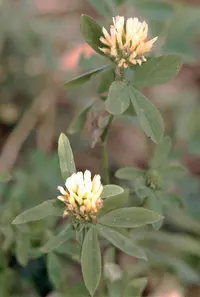
Egyptian clover (Trifolium alexandrinum) is an annual forage legume grown mainly for animal feed and soil improvement. It forms soft, upright stems with dense trifoliate leaves and small creamy-white clover heads.
This species originates from the Mediterranean and Middle Eastern regions but is now cultivated in many warm-temperate and subtropical areas. It grows quickly, fixes nitrogen in the soil, and generally tolerates regular cutting or grazing.
Gardeners who care for Egyptian clover usually value it as a cover crop or green manure rather than a decorative plant. It prefers full sun, consistent moisture, and fertile, well-drained soil for best performance.

Care Difficulty
Moderate Care

Light Preference
Full Sun

Water Requirements
Regular Water

Temperature Preference
Warm Climate

Hardiness Zone
8–11

Soil Texture
Sandy, Loamy, Silty

Soil pH
Slightly acidic (6.5–7.0), Neutral (7.0)

Soil Drainage
Moist but well-drained

Fertilization
Minimal (feed rarely)
Scan your plant to receive care tips personalized for your specific plant
Available on iOS and Android
Trifolium alexandrinum grows best with abundant light but is sensitive to extremes.
Water management for Trifolium alexandrinum focuses on steady moisture without waterlogging.
This clover prefers mild, cool to warm conditions and struggles with frost and extreme heat.
This annual legume tolerates a wide humidity range and rarely needs special humidity control outdoors.
This species prefers moderately fertile, well-drained mineral soil that still retains some moisture.
This species can be grown in containers if the pot allows enough root volume and stable moisture.
Trifolium alexandrinum benefits from modest feeding on fertile soils, mainly to support strong leafy growth and flowering.
Pruning Trifolium alexandrinum focuses on managing stand health and encouraging fresh regrowth rather than shaping individual plants.
This species is usually field-sown, so transplanting young Trifolium alexandrinum seedlings needs gentle handling to avoid root disturbance.
Propagation of Trifolium alexandrinum is done almost exclusively from seed for uniform stands and strong root systems.
In mild-winter regions, Egyptian clover can act as a cool-season annual, needing only basic winter management.

Plant Health Check
Not sure what's wrong with your plant? Check your plant's health inside the app.
This species was already cultivated as a major fodder crop in the Nile Delta in ancient times and is still a key winter forage in Egypt and surrounding regions today.
Unlike many clovers, it is a strictly annual plant that completes its entire life cycle in one cool season and then dies, relying on large seed production for persistence.
Its foliage has relatively high protein content for a forage legume and is widely used fresh or as hay and silage to feed cattle and buffalo in Mediterranean and South Asian farming systems.

This clover is highly valued in crop rotations because, as a nitrogen-fixing legume, it can leave substantial biologically fixed nitrogen in the soil, which helps support higher yields in subsequent cereal crops without relying solely on synthetic fertilizer.
This species is grown widely as forage and green fodder for livestock, and young shoots are sometimes used as animal feed. It is not commonly eaten by humans and should only be consumed if sourced from uncontaminated, chemical-free fields.
Keep your plants happy and healthy with plant identification, disease detection, and easy care guidance.