Australian Pig Face Care (Carpobrotus rossii)

Australian Pig Face

About Australian Pig Face

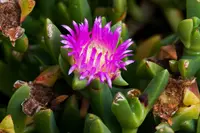
Australian pig face, Carpobrotus rossii, is a low, spreading succulent groundcover known for its fleshy triangular leaves and bright daisy-like flowers in pink to purple shades. It forms dense mats that help stabilize sandy soils and suppress weeds.

This species is native to coastal areas of southern Australia, where it grows on dunes and rocky headlands exposed to sun, wind, and salt. Its toughness and drought tolerance make it suitable for low-maintenance gardens and coastal landscapes.

In cultivated settings, it prefers full sun, well-drained sandy or gritty soil, and infrequent watering once established. These traits mean it is generally straightforward to care for Australian Pig Face in dry, sunny climates.

Main Plant Requirements

Care Difficulty

Easy Care

Light Preference

Full Sun

Water Requirements

Low Water

Temperature Preference

Tropical / Frost Sensitive

Hardiness Zone

9–11

Soil Texture

Sandy, Loamy, Rocky

Soil pH

Slightly acidic (6.5–7.0), Slightly alkaline (7.0–7.5)

Soil Drainage

Well-drained

Fertilization

Minimal (feed rarely)

Get Personalized Care Plan

Scan your plant to receive care tips personalized for your specific plant

Available on iOS and Android

How to Care for the Australian Pig Face

This coastal succulent thrives with strong light and benefits from direct sun exposure.

  • Provide 6–8 hours of direct sun daily; full sun promotes dense growth and abundant flowers in Australian Pig Face.
  • It tolerates light afternoon shade, especially in hotter inland areas, but too much shade causes lanky stems and fewer blooms.
  • In summer heatwaves, young plants may scorch in harsh afternoon sun; use temporary shade cloth, and ensure winter sites are not permanently shaded.

This drought-tolerant succulent prefers infrequent, deep watering and very fast-draining soil.

  • In the ground, water only when the top 3–5 cm of soil is completely dry; established Carpobrotus rossii may need no supplemental water in coastal climates.
  • Increase watering slightly in active spring–summer growth, reducing to rare watering in cool or rainy seasons.
  • Watch for soft, yellowing, or translucent leaves as a sign of overwatering; severe shriveling and limp, wrinkled leaves indicate underwatering.

This species prefers mild, coastal-type temperatures and dislikes prolonged frost.

  • Ideal growth occurs around 60–80°F (16–27°C), with best flowering in bright, cool to warm conditions.
  • It tolerates brief drops to about 25°F (-4°C) if soil is very free-draining, but repeated hard frosts can kill young plants.
  • In hot spells above 90°F (32°C), it generally copes well if soil is not waterlogged; protect from reflected heat off walls or pavement to reduce leaf scorch.

This coastal succulent handles a wide humidity range and rarely needs special adjustment indoors.

  • Performs well at 30–60% humidity, similar to most heated or air‑conditioned homes.
  • Tolerates very dry air due to its thick, water-storing leaves, so extra misting is unnecessary.
  • If foliage shrivels while soil stays consistently moist, airflow is too low; increase air movement rather than humidity, which suits Australian Pig Face.

This species prefers very free-draining, sandy soil that mimics coastal dune conditions.

  • Use a gritty mix of about 60–70% coarse sand or fine gravel with 30–40% cactus/succulent potting mix for structure and nutrients.
  • Ensure rapid drainage; water should run through within seconds, leaving no puddling or heavy, sticky patches in the container or bed.
  • Aim for slightly acidic to neutral pH around 6.0–7.0, which suits Carpobrotus rossii root function and nutrient uptake.
  • Avoid compacted clay, peat-heavy, or water-retentive mixes, which greatly increase the risk of root and stem rot.

This low, spreading succulent is suitable for containers, especially hanging baskets or shallow wide pots.

  • Choose a wide, shallow container so the mat-forming stems can root along the surface without deep, unused soil that stays wet.
  • Use a heavy or weighted pot outdoors in windy sites because the trailing mass can act like a sail and tip light containers.
  • Leave a clear, bare rim space at the top so fast-flowing water during irrigation does not wash the loose, sandy mix over the edge.

This coastal succulent needs only light feeding to stay healthy and flowering.

  • Use a low-rate, balanced slow-release fertilizer (around 10-10-10) or a thin top-dress of compost in spring.
  • Feed established plants once at the start of the growing season; avoid multiple applications in poor, sandy soils.
  • Apply at half the label strength to prevent soft, weak growth and salt buildup around the roots.
  • Skip feeding in winter or during dormancy, as Australian Pig Face rests and uses stored nutrients.

Light pruning helps keep Carpobrotus rossii dense, tidy, and flowering well.

  • Best time is late winter to early spring, before strong new growth begins.
  • Remove dead, damaged, or rotting stems, and thin out crowded runners to improve air flow.
  • Shorten overly long, straggly shoots to maintain a low, even carpet and prevent smothering nearby plants.
  • Use clean, sharp scissors or hand pruners, cutting above healthy nodes and avoiding heavy cutting into old woody bases.

This groundcover is usually transplanted outdoors rather than repotted frequently.

  • Transplant in spring or early summer when soil is warming and growth is active.
  • Look for signs such as roots filling nursery pots, water running off quickly, or slowed growth in containers.
  • Move plants every 3–4 years if they outgrow their space, choosing a sunny, very free-draining sandy site.
  • Water the old pot well, lift with as much root ball as possible, replant at the same depth, then water once to settle soil and allow it to dry slightly between later waterings.

Carpobrotus rossii is commonly propagated from stem cuttings and natural layering.

  • Take 5–10 cm stem cuttings in late spring or summer from firm, non-flowering shoots.
  • Remove lower leaves and lay or insert the cut base into a gritty, free-draining mix kept just slightly moist.
  • Encourage layering by pinning trailing stems onto sandy soil until new roots form, then sever and transplant.
  • Seeds can be sown in warm conditions with bright light, using a sandy mix and light surface coverage for best germination.

This coastal succulent prefers mild winters and needs protection in colder climates.

  • Plants tolerate light frosts but can be damaged by prolonged freezes below about 25°F.
  • In marginal climates, add a thin gravel or coarse sand mulch to keep the crown drier in winter.
  • Move container plants indoors or to a cold, bright, frost-free porch when hard frosts are forecast.
  • Ensure winter sites have excellent drainage so roots do not sit in cold, saturated soil.

Care Tips

Control Spreading Edges

Edge beds with pavers or a shallow root barrier 10–15 cm deep to keep this vigorous groundcover from smothering nearby plants while still allowing it to fill in as a living mulch.

Encourage Flower Flush

Lightly tip-prune a small portion of vigorous runners at the end of winter to stimulate branching and produce a denser mat with more flowering points in spring.

Use Cuttings Strategically

When trimming back overgrown sections, replant healthy, non-woody stem pieces by pinning nodes to the soil surface, creating quick new patches to repair bare or eroded areas.

Improve Coastal Resilience

In windy or coastal sites, lightly top-dress around stems once a year with coarse sand or fine gravel to stabilize runners, support rooting at nodes, and reduce abrasion from blown debris.

Monitor Salt Runoff

If plants grow near roads or paths treated with de-icing salts, occasionally flush the root zone with a deep, slow watering to dilute accumulated salts and prevent leaf burn when caring for Australian Pig Face.

Common Pests and Diseases

Aphids

This pest feeds on young, succulent growth, sucking sap and causing distortion, sticky honeydew, and sooty mold on leaves and stems.

Solution

Rinse colonies off the foliage with a firm stream of water, then spot-treat remaining clusters with insecticidal soap or a light horticultural oil, repeating weekly until controlled; encourage natural predators such as lady beetles by avoiding broad‑spectrum chemicals near the planting area.

Mealybugs

These insects hide in leaf joints and along stems, forming white cottony clusters that weaken plants by sap feeding and may lead to yellowing and stunted growth.

Solution

Dab visible clusters with cotton swabs dipped in isopropyl alcohol, then follow with thorough sprays of insecticidal soap every 7–10 days until no new insects appear, inspecting closely around stem nodes and dense mats of foliage common in Carpobrotus rossii care.

Scale insects

This pest appears as small, immobile bumps on stems and leaves, causing yellow patches, poor growth, and sticky honeydew that can attract ants.

Solution

Scrape or rub off individual scales with a soft brush or cloth, prune heavily infested stems, and apply a light horticultural oil to thoroughly coat remaining insects, repeating after 2–3 weeks if activity persists.

Fungal leaf spot

This disease produces small brown or dark purple spots on the fleshy leaves, sometimes enlarging and causing tissue collapse in humid or poorly ventilated conditions.

Solution

Remove and discard affected leaves, improve air flow and avoid wetting foliage during irrigation, then apply a sulfur or copper-based fungicide labeled for ornamental succulents if spotting continues to spread.

Botrytis blight

This disease causes soft, water-soaked patches on leaves and stems that may develop a gray, fuzzy mold, especially in cool, damp weather or where foliage stays wet.

Solution

Cut away and discard all affected tissue, reduce overhead watering, space plants to dry quickly, and if conditions stay cool and humid, use a suitable ornamental fungicide as a preventive spray on remaining healthy growth.

Interesting Facts

Coastal dune stabilizer

This species naturally grows on coastal dunes in southern Australia, where its dense, creeping mats help trap wind-blown sand and stabilize shorelines against erosion.

Edible salty berries

The fleshy fruits are edible and have a mildly salty, slightly tangy taste; they have been traditionally eaten by some Aboriginal Australian communities as part of a coastal food resource.

High salt tolerance

Its succulent leaves and specialized salt-tolerant physiology allow it to thrive close to the ocean, enduring salt spray and sandy, low-nutrient soils that many other plants cannot tolerate.

Botan icon

Did you know?

Carpobrotus rossii is one of the few native Australian iceplants that has been introduced to other countries both intentionally for dune stabilization and unintentionally, where it can sometimes behave as an environmental weed in coastal habitats.

FAQs about Australian Pig Face

Lack of flowers usually comes from insufficient light, poor drainage, or heavy feeding with high-nitrogen fertilizer. Ensure very bright conditions, lean sandy soil, and avoid frequent fertilizing so energy goes into flowering instead of leafy growth.

Grow Healthy Plants with Botan Care

Keep your plants happy and healthy with plant identification, disease detection, and easy care guidance.

Botan plant care app — identify plants on mobile

Explore More Plants