Early trunk support
Install sturdy stakes or a low, rigid frame when the palm is still young so the heavy, spreading crown has stable support as the trunk thickens and wind load increases.

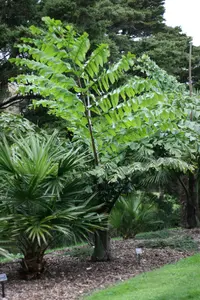
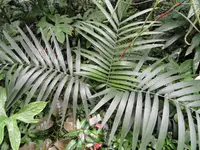
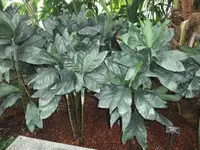
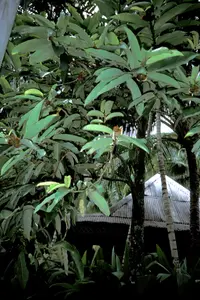
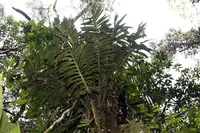
The giant fishtail palm, Caryota obtusa, is a large, fast-growing palm tree known for its broad, triangular fronds that resemble a fish’s tail. It develops a stout trunk and a dramatic, spreading crown, making it more suitable for spacious gardens and large landscapes than small homes. Native to parts of Southeast Asia and the Himalayan region, it thrives in warm, tropical to subtropical climates. This species prefers bright light, consistent moisture, and well-drained soil, and it can be demanding in cooler or very dry conditions. Understanding how to care for Giant fishtail palm is important, as its size, water needs, and sensitivity to cold can make it challenging for beginners.

Care Difficulty
Moderate Care

Light Preference
Partial Sun

Water Requirements
Regular Water

Temperature Preference
Tropical / Frost Sensitive

Hardiness Zone
10–11

Soil Texture
Sandy, Loamy, Organic-rich

Soil pH
Acidic (5.5–6.5), Slightly acidic (6.5–7.0)

Soil Drainage
Moist but well-drained

Fertilization
Light (every 4–6 weeks)
Scan your plant to receive care tips personalized for your specific plant
Available on iOS and Android
This palm prefers bright, filtered light similar to high, broken canopy sun in the tropics.
This palm prefers consistently moist but not waterlogged soil around its deep root system.
This large palm thrives in warm, frost‑free climates with stable temperatures.
This palm prefers moderately humid air but adapts if extremes are avoided.
Caryota obtusa prefers deep, loose, well-drained, organic-rich soil that still holds steady moisture.
This large palm can be grown in containers when young or in restricted spaces, but needs careful pot choice for stability and root health.
Caryota obtusa benefits from moderate, consistent feeding during its active growth phase.
Pruning Caryota obtusa focuses on removing spent or unhealthy tissue rather than reshaping the palm.
Transplanting this large palm is done infrequently and should be planned carefully to limit root disturbance.
Propagation of Caryota obtusa is usually done from seed and is considered slow and specialized rather than routine home care.
This palm prefers warm climates and requires thoughtful winter care in regions with frost or freezing temperatures.

Plant Health Check
Not sure what's wrong with your plant? Check your plant's health inside the app.
This palm grows a huge, dense crown of bipinnate, fishtail-shaped leaves and then flowers only once in its lifetime, producing multiple tiers of hanging inflorescences before the entire trunk dies back, a strategy known as monocarpy.
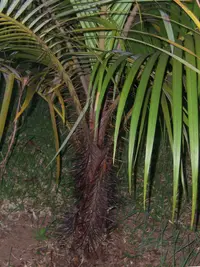
Mature individuals in suitable habitat develop very stout gray trunks that can exceed 30–40 cm in diameter, giving the plant a noticeably bulkier appearance than many other fishtail palm species.
It is native to montane forests of northern India and Southeast Asia, where it naturally occurs at higher elevations than many tropical palms, often in cooler, humid valleys and forest edges.

The inflorescences of this species emerge progressively from the top of the trunk downward over several years, with the lowest flower clusters appearing last; only after this sequence of flowering and fruiting is completed does the trunk die, while any separate trunks in a clump may continue to live and repeat the cycle.
Growth is moderately fast in warm, humid climates with good soil and regular watering, often adding 30–90 cm per year. In containers or cooler areas, growth slows noticeably due to root restriction and lower temperatures.
Keep your plants happy and healthy with plant identification, disease detection, and easy care guidance.