Rotate for symmetry
Rotate the pot 90° every 2–3 weeks so the broad leaf blades develop evenly and the trunk stays vertical instead of leaning toward the light source.

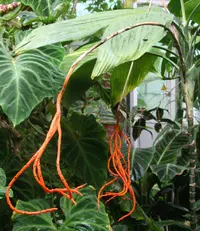
Chamaedorea ernesti-augusti is a compact, clustering palm valued for its broad, simple leaves that resemble small banana foliage rather than the usual feathery palm fronds. It typically forms slender, cane-like stems with a graceful, upright habit that suits tabletops, shelves, and small floor spaces.
This species is native to humid forests of Central America, where it grows in shaded understory conditions with consistently moist but well-drained soil. In cultivation it is considered moderately easy, as long as it receives soft, indirect light, even moisture, and protection from cold drafts. Understanding how to care for Chamaedorea ernesti-augusti mainly involves providing stable indoor conditions and avoiding extremes in light and dryness.

Care Difficulty
Moderate Care

Light Preference
Bright Indirect Light

Water Requirements
Moderate Water

Temperature Preference
Tropical / Frost Sensitive

Hardiness Zone
10–11

Soil Texture
Loamy, Organic-rich

Soil pH
Acidic (5.5–6.5), Slightly acidic (6.5–7.0)

Soil Drainage
Moist but well-drained

Fertilization
Light (every 4–6 weeks)
Scan your plant to receive care tips personalized for your specific plant
Available on iOS and Android
This shade-tolerant palm prefers soft, filtered light rather than direct, intense sun.
Watering should keep the root zone lightly moist but never waterlogged.
This species prefers warm, stable conditions without sudden temperature swings.
This palm prefers moderately humid air and reacts if conditions become too dry.
This species needs a loose, airy, organic-rich mix that drains quickly yet holds some moisture.
This palm is well suited to container culture for patios or interiors.
This palm benefits from modest feeding to support steady foliage growth in containers.
Pruning is mainly cosmetic and helps maintain a tidy, healthy canopy.
This species prefers slightly snug pots and does not need frequent repotting.
Propagation is possible but slow, most often done from seeds rather than by division.
This palm is frost-sensitive and needs protection in cooler climates.

Plant Health Check
Not sure what's wrong with your plant? Check your plant's health inside the app.
This species naturally occurs along moist, shaded streambanks and forest floors in southern Mexico and Central America, often forming small colonies under dense canopy cover.
Unlike many feathery Chamaedorea palms, it develops relatively large, simple leaves that can become shallowly lobed or split with age, giving it a distinct paddle-like appearance.
Its leaf structure and dark green pigmentation are adapted to capture low, filtered light in tropical understories, which is why it maintains good photosynthetic performance in shade compared to many other small palms.
Growth is moderate rather than fast. In average indoor conditions, it usually adds 5–15 cm of height per year. Consistent warmth, stable moisture, and regular light fertilization improve vigor and make growing Chamaedorea ernesti-augusti more predictable.
Keep your plants happy and healthy with plant identification, disease detection, and easy care guidance.