

Host plant planning
Select sturdy, drought-tolerant host shrubs or trees and space them so the stems of this parasitic vine can easily bridge between plants without needing artificial supports.

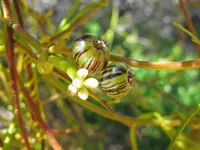
Coarse dodder-laurel (Cassytha melantha) is a leafless, twining parasitic vine native to Australia. It grows over host shrubs and trees, forming dense, tangled mats of slender green to yellow stems. Small clustered flowers and berry-like fruits appear along the stems, giving it a distinctive, beaded look. Because it depends on host plants for water and nutrients, it behaves very differently from typical houseplants or garden shrubs. Gardeners who want to care for Coarse Dodder-laurel need to understand its parasitic nature and legal status, since it can be considered a problem weed in some regions. It generally favors sunny, well-drained, low-fertility sites where suitable hosts are present.

Care Difficulty
Moderate Care

Light Preference
Full Sun

Water Requirements
Low Water

Temperature Preference
Warm Climate

Hardiness Zone
9–11

Soil Texture
Sandy, Loamy

Soil pH
Slightly acidic (6.5–7.0), Neutral (7.0)

Soil Drainage
Well-drained

Fertilization
Minimal (feed rarely)
Scan your plant to receive care tips personalized for your specific plant
Available on iOS and Android
This hemiparasitic climber needs strong natural light to photosynthesize effectively.
Cassytha melantha is adapted to dry, free-draining sites and takes most resources from its host rather than the soil.
This species prefers warm, frost-free conditions typical of mild to hot climates.
Humidity is not a primary concern for Cassytha melantha, which copes well in typical outdoor air conditions.
This hemiparasitic vine does not rely on a conventional potting substrate but benefits from a very free-draining, mineral-based medium if grown in a managed setting.
This species is generally unsuitable for long-term container growing because it depends on living host plants in open ground.
Cassytha melantha is a parasitic vine that usually gains nutrients from its host and rarely benefits from additional fertilizer in the soil or container.
Pruning Cassytha melantha focuses on controlling spread and maintaining the health of host plants it grows on.
Transplanting this twining parasite is uncommon, as Cassytha melantha naturally establishes on suitable host plants in the landscape.
Propagation of Cassytha melantha is specialized, because the vine depends on forming haustoria, which are feeding connections, with a suitable host plant.
This species is adapted to mild, frost-free or light-frost climates and usually needs little structured winter care in suitable regions.

Plant Health Check
Not sure what's wrong with your plant? Check your plant's health inside the app.
This species is a leafless, twining stem parasite that naturally occurs on sandy coastal and inland sandplain habitats of southern Australia, where it taps into the vascular tissue of host shrubs to obtain water and nutrients.
Its fleshy green to blackish fruits are eaten by birds, which pass the seeds through their digestive tract and disperse them to new hosts, making frugivorous birds a key partner in its life cycle.
Although it can parasitize several woody hosts, it is especially associated with Myrtaceae and other shrub species in kwongan heath and similar vegetation, reflecting adaptation to nutrient-poor, fire-prone ecosystems.

Cassytha melantha can significantly reduce the growth and reproductive output of its host plants, and in dense infestations it may form extensive orange to yellow stem mats that alter local plant community structure in coastal heath and shrubland ecosystems.
This species is a parasitic vine that can spread quickly over suitable host shrubs, sometimes smothering them. In gardens it is usually considered a weed and should be carefully contained or removed to protect other plants.
Keep your plants happy and healthy with plant identification, disease detection, and easy care guidance.

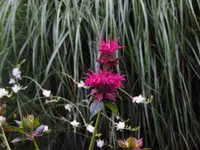
Bee Balm
Monarda didyma 'Raspberry Wine'
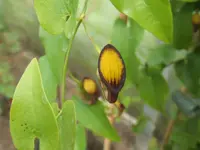
Climbing Birthwort
Aristolochia sempervirens
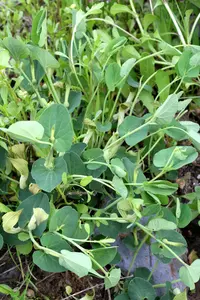
Aristolochia fontanesii
Aristolochia fontanesii
Firecracker Vine
Ipomoea lobata
sour gold-pored bolete
Aureoboletus auriporus
swamp jessamine
Gelsemium rankinii
Maidenhair tree
Ginkgo biloba
narrowleaf mountainmint
Pycnanthemum tenuifolium