Controlled Host Selection
Train stems onto fast-growing, non-valuable host plants (such as robust native shrubs) and regularly remove new strands that reach desirable ornamentals to keep its parasitic growth confined.

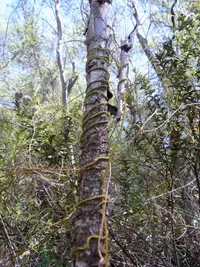
Devil's twine, Cassytha pubescens, is a slender, leafless parasitic vine that coils tightly around host plants, forming dense, tangled mats of yellow-green stems. It anchors itself using small suckers that draw water and nutrients from its hosts rather than from soil.
This species is native to Australia but has been introduced to parts of North America, where it is sometimes studied as a biological control agent against invasive shrubs. Its parasitic nature and fast growth make it challenging to manage in mixed plantings, so gardeners who choose to grow it need to understand how to care for Devil's Twine in controlled settings.
It generally favors sunny, open sites and relies on suitable host plants rather than specific soil conditions, which strongly shapes how and where it can be grown.

Care Difficulty
Hard Care

Light Preference
Full Sun

Water Requirements
Low Water

Temperature Preference
Warm Climate

Hardiness Zone
9–11

Soil Texture
Sandy, Loamy, Rocky

Soil pH
Slightly acidic (6.5–7.0), Neutral (7.0)

Soil Drainage
Well-drained

Fertilization
Minimal (feed rarely)
Scan your plant to receive care tips personalized for your specific plant
Available on iOS and Android
Cassytha pubescens thrives in bright, open sites with consistent sun exposure.
Cassytha pubescens is a hemiparasitic vine that relies mainly on host plants for water, so direct watering needs are low.
This species is adapted to warm, temperate to semi-arid climates with mild winters.
This parasitic twining vine tolerates a wide humidity range and usually does not need special humidity management outdoors.
This root-parasitic vine anchors into host plants, so soil preparation focuses on the host’s root zone rather than the vine itself.
This species is poorly suited to container growing because it depends on establishing on host plants in more natural, open conditions.
Cassytha pubescens is a low-nutrient, parasitic vine that usually needs no added fertilizer when established on suitable host plants.
Cassytha pubescens benefits from light, targeted pruning to keep growth in check and maintain host plant health.
This parasitic vine is seldom container-grown, so care focuses on managing and, if needed, relocating it on host plants outdoors.
Propagation of Cassytha pubescens is specialized because this vine depends on suitable host plants for survival.
This species is generally adapted to mild climates and usually needs only basic winter awareness rather than intensive protection.

Plant Health Check
Not sure what's wrong with your plant? Check your plant's health inside the app.
This species is a hemiparasitic vine that taps into the stems of host plants with specialized organs called haustoria, stealing water and nutrients while still performing some photosynthesis of its own.
In parts of southern Australia, it has been shown to significantly weaken invasive woody weeds such as gorse and broom, and is being studied as a potential native ally in ecological restoration.
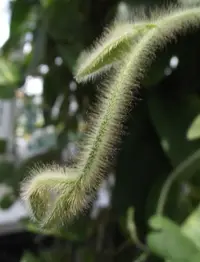
The slender, twining stems carry a covering of fine hairs (pubescence) that distinguish it from several other Cassytha species, which often have smoother, more glabrous stems.

Genetic and field studies have shown that this species can discriminate among potential hosts, often forming stronger and more frequent attachments to certain invasive or nitrogen-fixing plants, which may increase its impact on those targets within native ecosystems.
This species is a parasitic vine that can spread rapidly across suitable hosts, forming dense tangles. In gardens or restoration areas it often requires strict monitoring and regular removal to prevent smothering and weakening desirable vegetation.
Keep your plants happy and healthy with plant identification, disease detection, and easy care guidance.