Blackbean Care (Castanospermum australe)

Also known as: Moreton Bay Chestnut, Australian Chestnut
Blackbean

About Blackbean

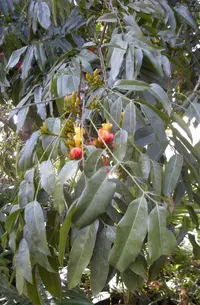
Blackbean, Castanospermum australe, is an evergreen tree from the rainforests and riverbanks of eastern Australia and nearby Pacific islands. It is often grown indoors as a compact foliage plant when young. The plant has glossy, dark green leaflets arranged along upright stems, giving it a dense, tropical look. In nature it becomes a large tree with bright pods containing the distinctive orange-brown seeds. Growth is steady but not fast indoors, and it stays manageable for several years. It prefers bright, indirect light, evenly moist but not waterlogged soil, and good drainage. These traits make basic how to care for Blackbean reasonably straightforward for attentive plant owners.

Main Plant Requirements

Care Difficulty

Moderate Care

Light Preference

Bright Indirect Light

Water Requirements

Moderate Water

Temperature Preference

Tropical / Frost Sensitive

Hardiness Zone

10–11

Soil Texture

Loamy, Sandy, Organic-rich

Soil pH

Acidic (5.5–6.5), Slightly acidic (6.5–7.0)

Soil Drainage

Moist but well-drained

Fertilization

Minimal (feed rarely)

Get Personalized Care Plan

Scan your plant to receive care tips personalized for your specific plant

Available on iOS and Android

How to Care for the Blackbean

Castanospermum australe prefers bright, indirect light that mimics open forest edges.

  • Provide 4–6 hours of bright, filtered light daily, such as light through sheer curtains or under high, dappled shade outdoors.
  • Tolerates light morning sun but protect from strong midday and afternoon sun, which can scorch leaves and cause pale, crispy patches.
  • In partial shade it survives but may grow sparse; during short winter days, move closer to the brightest window to maintain compact growth.

This species prefers evenly moist but not waterlogged soil.

  • Water when the top 2–4 cm of soil feels dry, using enough water so it drains freely from the root zone.
  • In spring and summer, expect more frequent watering as growth and evaporation increase; reduce frequency in fall and winter while still preventing complete dry-out.
  • Watch for yellowing, soft leaves as a sign of overwatering and hard, curling, or brown-edged leaves as a sign of underwatering; always ensure well-draining soil.

This subtropical tree grows best in consistently warm, frost-free conditions.

  • Aim for 65–80°F (18–27°C) for active growth; short periods up to 86°F (30°C) are tolerated if soil moisture is stable.
  • Protect from temperatures below 45°F (7°C); brief exposure near 40°F (4°C) can cause leaf drop and damage to young tissue.
  • Blackbean is not frost-hardy, so shelter it from cold winds and sudden temperature swings, especially in fall and early spring.

Castanospermum australe prefers moderate indoor humidity and copes reasonably well with typical household air.

  • Aim for 40–60% humidity to limit leaf edge browning and maintain steady growth when caring for Blackbean.
  • Expect increased leaf tip crisping and dull, drooping foliage if humidity stays below 30% for extended periods.
  • Increase humidity by grouping plants, using a nearby tray with water and stones, or running a small room humidifier.

Castanospermum australe grows best in deep, moisture-retentive yet free-draining soil that mimics a fertile riverbank.

  • Use a loamy mix containing roughly 50% peat-free potting mix, 25% compost, and 25% coarse material such as perlite or pine bark for structure.
  • Ensure rapid drainage so water does not pool at the bottom; the mix should feel springy, not sticky or compacted after watering.
  • Aim for slightly acidic to neutral pH around 6.0–7.0, avoiding very alkaline substrates that can suppress nutrient uptake.
  • Improve aeration and root health by blending in coarse sand or fine bark chips and never growing it in heavy, unamended clay.

This species adapts well to container growing when the pot supports its strong, eventually woody root system.

  • Choose a tall, heavy container that resists tipping as the canopy becomes denser and more top-heavy.
  • Select a pot material with moderate weight, such as thick ceramic, to stabilize the plant while preventing the mix from drying out too rapidly.
  • Leave generous space below the drainage holes so excess water can escape freely and not be reabsorbed from a saucer.

This species grows slowly and needs only modest feeding, especially when grown as a Blackbean indoor care specimen.

  • Use a balanced liquid fertilizer (e.g. 10-10-10 or 20-20-20) at 1/2 strength during active growth in spring–summer.
  • Feed every 4–6 weeks, skipping applications if growth is already strong or foliage is very dark green.
  • Avoid feeding in late fall and winter when growth slows, to prevent weak, elongated shoots.
  • In large containers or outdoor plantings, a light top-dressing of compost or slow-release pellets once in spring is sufficient.

Castanospermum australe needs light, occasional pruning mainly to maintain structure and remove problem growth.

  • Carry out pruning in late winter or early spring before strong new growth starts.
  • Remove dead, diseased, crossing, or storm-damaged branches using clean, sharp bypass pruners or loppers.
  • Shorten overly long or upright shoots to an outward-facing bud to encourage a fuller canopy and balanced shape.
  • Avoid heavy structural cuts on mature trees; instead, shape gradually over several seasons to reduce stress.

Young plants tolerate container culture for a few years, but this tree is usually shifted to the ground rather than kept long term in pots.

  • Check for roots circling the container, bulging pot sides, or slowed growth as signs that transplanting is needed.
  • Plan transplanting or upsizing for spring, every 2–3 years for young trees, when soil is warming and recovery is faster.
  • Water thoroughly the day before, then lift the root ball gently, keeping as much soil around the roots as possible.
  • Replant at the same depth in a wider hole or pot, backfill firmly, water well, and shade from strong sun for 1–2 weeks to limit root stress.

This tree is most commonly propagated from fresh seeds, as cuttings root poorly and are less reliable.

  • Collect mature, healthy seeds in late summer–fall and sow promptly, since viability drops during long storage.
  • Use a free-draining mix, such as 50% quality potting mix and 50% coarse sand or perlite, to prevent waterlogging.
  • Place seeds horizontally just beneath the surface and keep the medium evenly moist at 70–80°F for best germination.
  • Provide bright, indirect light and good air circulation; transplant seedlings only once roots and the first true leaves are well developed.

This tropical tree is frost-sensitive and needs protection in regions with cold winters, especially when young or container grown.

  • In climates where temperatures drop below 30°F, grow in containers so plants can be moved indoors or into a greenhouse for winter.
  • Keep indoor plants in bright light, reduce watering, and avoid cold drafts around windows and doors.
  • For in-ground trees in marginal climates, apply a 5–8 cm mulch layer over the root zone, keeping it slightly away from the trunk.

Care Tips

Rootball management

When potting on, keep the woody taproot and main rootball intact and move up only 1 pot size at a time to avoid root shock and lanky top growth.

Seed shell handling

If the large seed halves remain attached above the soil, leave them in place until they dry and fall off naturally, as they provide stored energy and help stabilize the young trunk.

Canopy shaping

Begin light structural pruning while the plant is young by shortening only the soft tips of dominant shoots, which encourages a balanced, bushier canopy instead of a single tall stem.

Trunk strengthening

Rotate the container a quarter turn every 1–2 weeks and avoid staking unless necessary, so the trunk learns to support itself and thickens gradually in indoor conditions.

Salt and chlorine control

In areas with hard or heavily chlorinated tap water, use filtered or left-to-stand water for 24 hours, which reduces salt and chlorine stress that can cause marginal leaf burn when growing Blackbean.

Common Pests and Diseases

Scale insects

This pest attaches to stems and leaf veins, sucking sap and causing yellowing, leaf drop, and a sticky honeydew residue that can lead to sooty mold on the glossy leaves of this species.

Solution

Isolate the plant, then wipe stems and leaves with a cotton pad dipped in diluted alcohol or insecticidal soap, repeating weekly until new growth is clean; for heavier infestations on larger outdoor trees, horticultural oil sprays applied to all bark and leaf surfaces are effective when used according to label directions.

Mites

These insects are actually tiny arachnids that thrive in warm, dry indoor air, causing fine stippling, dull foliage, and delicate webbing on the undersides of compound leaves.

Solution

Increase humidity around the plant, then thoroughly hose or shower all foliage to remove mites, and follow with 2–3 applications of insecticidal soap or a light horticultural oil at 7–10 day intervals, paying special attention to leaflet undersides.

Leaf spot

This disease produces brown to dark purple circular or irregular spots on the leaflets, sometimes with yellow halos, which can merge and lead to partial defoliation under humid or overhead-watered conditions.

Solution

Remove and discard affected leaves, avoid wetting the foliage, and improve air circulation; if spotting continues to spread, apply a copper-based or broad-spectrum fungicide labeled for ornamental trees, coating both leaf surfaces according to label instructions.

Powdery mildew

This disease appears as a white, powdery film on the leathery leaflets, leading over time to distorted new growth and reduced vigor, especially in shaded, stagnant air conditions.

Solution

Prune to open the canopy and increase light and airflow, avoid overcrowding, then apply a sulfur or potassium bicarbonate fungicide to all leaf surfaces, repeating as directed until new growth emerges clean and unaffected.

Interesting Facts

Toxic but bird-dispersed

The large orange and black seeds are highly toxic to mammals, including humans, but native Australian birds such as the Torresian imperial pigeon can eat and disperse them without harm, helping the tree colonize riverbanks and rainforests.

Rainforest nitrogen fixer

This species is a legume that forms symbiotic root nodules with nitrogen-fixing bacteria, allowing it to enrich poor rainforest and riparian soils with biologically available nitrogen.

Flood-adapted seedling strategy

In its natural habitat along tropical Australian rivers, seedlings often establish on flood-prone banks, and their heavy seeds provide stored reserves that support early growth even when the substrate is periodically waterlogged.

Botan icon

Did you know?

The woody seeds of this species were traditionally leached and processed as an emergency food by some Aboriginal Australian groups, who developed complex methods to remove the toxins before consumption.

FAQs about Blackbean

Growth is moderate rather than extremely fast. Young trees may add 30–60 cm per year, slowing as they mature. In suitable climates it can eventually reach 10–20 m tall with a broad, dense canopy.

Grow Healthy Plants with Botan Care

Keep your plants happy and healthy with plant identification, disease detection, and easy care guidance.

Botan plant care app — identify plants on mobile

Explore More Plants