Plan root space
Position young trees at least 6–8 ft from foundations, drains, and paved areas because the root system becomes wide and shallow, and future surface roots can heave sidewalks or interfere with underground services.

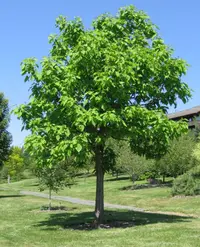
Northern catalpa (Catalpa speciosa) is a fast-growing deciduous tree valued for its broad crown, large heart-shaped leaves, and showy white spring flowers. It develops long, bean-like seed pods that remain on the tree into winter, giving it a distinctive appearance in the landscape.
This species is native to the central United States but is widely planted in urban and rural areas as a shade and ornamental tree. It adapts to a range of soils and tolerates city conditions, which generally makes it straightforward to care for northern catalpa.
The tree prefers full sun, moderately moist but well-drained soil, and space to accommodate its mature size and spreading roots.

Care Difficulty
Easy Care

Light Preference
Full Sun

Water Requirements
Moderate Water

Temperature Preference
Cold Hardy

Hardiness Zone
4–8

Soil Texture
Sandy, Loamy, Clay

Soil pH
Slightly acidic (6.5–7.0), Slightly alkaline (7.0–7.5)

Soil Drainage
Moist but well-drained

Fertilization
Minimal (feed rarely)
Scan your plant to receive care tips personalized for your specific plant
Available on iOS and Android
Catalpa speciosa grows best as a full-sun landscape tree with some tolerance for light shade.
Catalpa speciosa prefers evenly moist, well-drained soil while establishing, then becomes moderately drought tolerant.
This species is a hardy deciduous tree adapted to continental climates with cold winters and warm summers.
Humidity is rarely a concern, as this species is naturally adapted to outdoor air conditions across much of its range.
This tree prefers deep, moderately fertile, well-aerated soil that stays evenly moist but not saturated.
This species is not well-suited to long-term container growing due to its eventual large size and vigorous root system.
This fast-growing tree benefits from light feeding on poor soils but established specimens usually need little fertilizer.
Pruning Catalpa speciosa helps maintain safe structure and manage size without reducing flowering too much.
This tree is usually grown in the ground, so focus on careful transplanting of young specimens rather than long-term container culture.
Catalpa speciosa is most often propagated from seed, with cuttings used less commonly for specific selections.
This species is cold hardy in much of the US and usually needs minimal winter care once established.

Plant Health Check
Not sure what's wrong with your plant? Check your plant's health inside the app.
In much of its native range, the northern catalpa is primarily pollinated at night by the catalpa sphinx moth (Ceratomia catalpae), whose long proboscis can easily reach nectar deep inside the tubular flowers.
This tree develops long, narrow seed pods that can reach 20–40 cm and hang on the branches through winter, which has led to common names like cigar tree and Indian bean tree.
The wood of northern catalpa is naturally resistant to rot and insect damage, so it was historically used for fence posts, railroad ties, and other outdoor structures that needed to last in wet soil.

The northern catalpa was widely planted outside its original Midwestern and lower Mississippi Valley range as an ornamental and shade tree, and has since naturalized in many parts of the eastern and central United States, making it difficult to distinguish planted from truly native populations in some regions.
This species is generally fast-growing, often adding 30–60 cm or more per year once established. Growth is quickest in full sun with adequate moisture and deep soil, and slows in compacted, dry, or nutrient-poor sites.
Keep your plants happy and healthy with plant identification, disease detection, and easy care guidance.