Avoid physical disturbance
Place substrates with the lichen where they will not be brushed, handled, or shaken, since repeated mechanical damage easily breaks apothecia and slows regrowth for years.

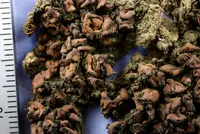
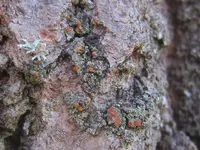
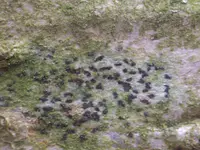
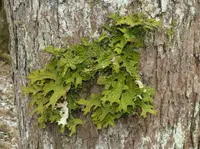
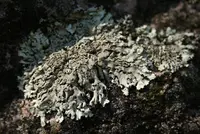
Catillaria nigroclavata is a crustose lichen, not a true plant, forming thin, flat patches tightly attached to bark or rock. It often appears as dark, finely dotted crusts. This species occurs mainly in temperate regions, especially on tree trunks in woodlands, parks, and older hedgerows. It is typically slow-growing and depends on clean to moderately clean air, so it may struggle in heavily polluted urban areas. Because it obtains nutrients from rain, dust, and the substrate surface, it does not need regular fertilization or rich soil. Those who want to learn how to care for catillaria lichen should focus on stable moisture, cool conditions, and shelter from harsh disturbance.

Care Difficulty
Hard Care

Light Preference
Partial Shade

Water Requirements
Low Water

Temperature Preference
Cool Climate

Hardiness Zone
Unknown

Soil Texture
Rocky, Sandy

Soil pH
Strongly acidic (4.5–5.5), Acidic (5.5–6.5)

Soil Drainage
Well-drained

Fertilization
Minimal (feed rarely)
Scan your plant to receive care tips personalized for your specific plant
Available on iOS and Android
This crustose lichen prefers cool, stable light typical of shaded tree bark or stone surfaces.
This lichen relies on natural wetting and drying cycles rather than regular, heavy watering.
This species tolerates a broad outdoor temperature range but grows best in cool to mild conditions.
This crustose lichen is highly tolerant of low humidity and usually does not require active humidity management.
Catillaria nigroclavata naturally grows on bark or rock surfaces rather than in conventional soil.
This species is suitable for container culture only as a mounted or surface lichen on stones or bark pieces rather than a rooted plant in potting mix.
This crustose lichen grows on nutrient-poor bark and usually needs no added fertilizer in cultivation.
Pruning is generally unnecessary for Catillaria nigroclavata because the lichen naturally maintains a low, crust-like form.
Transplanting focuses on moving the host substrate, since the lichen itself does not respond well to disturbance.
Propagation of this species is slow and specialized, so routine home propagation is rarely attempted.
Established colonies on hardy trees usually tolerate normal outdoor winters in temperate climates without intervention.

Plant Health Check
Not sure what's wrong with your plant? Check your plant's health inside the app.
This crustose lichen often colonizes bark and twigs in towns and cities, and its continued presence in moderately polluted areas is used by lichenologists as evidence that air quality has not reached the most extreme pollution levels.
It shows a strong preference for smooth-barked broadleaved trees and shrubs, such as hawthorn and ash, where its tiny black apothecia form dense, often coalescing patches on the pale bark surface.
The species is widespread across much of Europe, from lowland agricultural landscapes to urban parks and hedgerows, and is frequently recorded in lichen surveys as a common but easily overlooked component of bark communities.
This crustose lichen grows very slowly, often only fractions of a millimeter per year. Growth rate depends strongly on moisture, air quality, light exposure, and the stability of the bark or stone it colonizes.
Keep your plants happy and healthy with plant identification, disease detection, and easy care guidance.