Provide climbing support
Install a sturdy trellis, moss pole, or horizontal wires early so the stems can be gently tied and trained, which keeps the plant upright, improves light exposure, and prevents breakage of brittle flowering shoots.

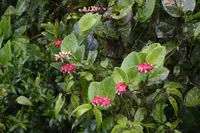
Cavendishia complectens is a woody, evergreen shrub or vine in the blueberry family, valued for its decorative foliage and tubular flowers. It often grows as an epiphyte, rooting into mossy tree branches rather than soil. Native to humid cloud forests of Central and South America, it prefers cool, stable temperatures and consistently moist air. These natural conditions make it more challenging than common houseplants. In cultivation, it usually needs bright, filtered light, high humidity, and acidic, well-drained media similar to those used for orchids or ericaceous shrubs. Understanding this background is important for anyone learning how to care for Cavendishia complectens.

Care Difficulty
Hard Care

Light Preference
Partial Shade

Water Requirements
Keep Soil Moist

Temperature Preference
Tropical / Frost Sensitive

Hardiness Zone
Unknown

Soil Texture
Loamy, Peaty, Organic-rich

Soil pH
Strongly acidic (4.5–5.5), Acidic (5.5–6.5)

Soil Drainage
Moist but well-drained

Fertilization
Light (every 4–6 weeks)
Scan your plant to receive care tips personalized for your specific plant
Available on iOS and Android
Provide bright, indirect light similar to high-elevation forest edges.
Maintain evenly moist but never waterlogged soil for this shrub.
Keep conditions mild and frost free to mimic cloud forest habitat.
This cloud-forest shrub needs consistently high humidity to grow well indoors or in sheltered outdoor spots.
This species needs an acidic, airy, and sharply draining mix similar to that used for epiphytic blueberries or orchids.
This species is well suited to container growing, especially in climates that are cooler or drier than its native habitat.
Nutrient-rich, acidic conditions support steady growth and flowering in Cavendishia complectens.
Thoughtful pruning keeps Cavendishia complectens compact, healthy, and flowering well.
Container-grown plants benefit from occasional repotting or transplanting to maintain strong roots and stable growth.
Vegetative propagation is possible but somewhat specialized for this species.
This tropical shrub is frost-sensitive and needs protection in climates with cool winters.

Plant Health Check
Not sure what's wrong with your plant? Check your plant's health inside the app.
This species is native to high Andean cloud forests, where it grows as a shrub or hemiepiphyte on humid, mossy trees in cool, misty conditions.
Its tubular, brightly colored flowers are adapted for pollination by hummingbirds, which can access the nectar with their long bills while transferring pollen between plants.
The fruits are small, often blue to purplish berries that belong to the blueberry family (Ericaceae), and in nature they provide food for birds and other wildlife.
This species performs best outdoors in mild, humid, frost-free climates, where light and airflow are higher. Indoor culture is possible in bright, cool, conservatory-like conditions. Protect it from temperature extremes, dry air, and low light to maintain vigor.
Keep your plants happy and healthy with plant identification, disease detection, and easy care guidance.

-200x200.webp)