Trunk protection strategy
In regions with occasional frost, wrap the young trunk with breathable frost cloth or use a temporary wooden shade board on the south or west side to prevent sunscald and cold cracks as the bark is still thin.

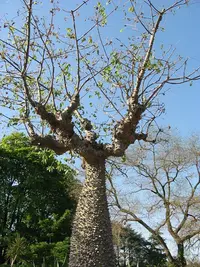
The white silk floss tree (Ceiba insignis) is a deciduous tree known for its swollen, bottle-shaped trunk often covered with sharp conical spines. It develops a broad canopy of sparse branches and showy white to pale pink flowers that appear on bare branches before or with new leaves.
This species is native to dry forests of South America, especially in Argentina and surrounding regions, and is adapted to seasonal drought. It can be grown outdoors in frost-free climates or as a large container specimen in bright, sunny spots. Thick, water-storing trunks and drought tolerance make it relatively forgiving once established, though care for white silk floss tree still requires well-drained soil and protection from hard frost.

Care Difficulty
Moderate Care

Light Preference
Full Sun

Water Requirements
Low Water

Temperature Preference
Tropical / Frost Sensitive

Hardiness Zone
10–11

Soil Texture
Sandy, Loamy

Soil pH
Slightly acidic (6.5–7.0), Neutral (7.0)

Soil Drainage
Well-drained

Fertilization
Minimal (feed rarely)
Scan your plant to receive care tips personalized for your specific plant
Available on iOS and Android
This species grows best in strong light typical of open, warm climates.
Ceiba insignis prefers dry to moderately moist soil with distinct drying between waterings.
This tree is adapted to warm, frost-free to very light-frost climates.
This species tolerates a wide humidity range and usually does not need special humidity management indoors or outdoors.
Ceiba insignis prefers a fast-draining, mineral-lean substrate that mimics semi-arid woodland conditions.
This species can be grown in containers, especially in cooler climates where in-ground planting is not practical.
Ceiba insignis grows adequately in average soil but responds well to light, controlled feeding in containers or poor ground.
Pruning Ceiba insignis is mainly done to remove problem wood and manage structure rather than to control size.
This species is usually grown in the ground, so focus on careful transplanting of young trees rather than frequent repotting.
Propagation of Ceiba insignis is typically done from seed, as vegetative methods are less consistent for home growers.
In mild climates this tree needs minimal winter attention, but it is sensitive to hard frost and prolonged freezing.

Plant Health Check
Not sure what's wrong with your plant? Check your plant's health inside the app.
This species develops a swollen, bottle-like trunk that stores water, an adaptation to the long dry seasons in its native arid forests of western South America.
The bark is green and rich in chlorophyll, allowing the tree to photosynthesize directly through its trunk and branches even when it has shed most of its leaves.
The trunk and older branches are covered with hard conical spines that help protect the tree from herbivores and may also reduce bark overheating by casting small patches of shade.

Ceiba insignis produces large, showy, pale flowers on mostly leafless branches, a pattern called cauliflory or near-cauliflory in which blooms appear on bare woody stems and can be easily accessed by pollinators such as bats and large insects during the dry season.
Lack of flowering usually comes from youth, insufficient light, or stress from cold, pruning, or root disturbance. Mature trees bloom most reliably after several warm, stable seasons with full sun exposure and no heavy pruning of flowering wood.
Keep your plants happy and healthy with plant identification, disease detection, and easy care guidance.