Early staking plan
Install sturdy stakes or discreet wire supports in early spring while shoots are under 30 cm tall so the tall stems can grow through and remain upright in wind and rain.

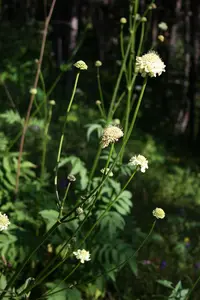
Tatarian cephalaria (Cephalaria gigantea) is a tall, herbaceous perennial grown mainly for its airy, pale yellow, pincushion-like flower heads. It forms upright clumps of strong stems with deeply divided green leaves, creating a loose, transparent screen rather than a solid hedge. Native to parts of Eastern Europe and western Asia, it is typically found in meadows and open, sunny places. In gardens it suits mixed borders and naturalistic plantings, where it attracts bees and other pollinators. Cephalaria gigantea is generally easy to grow if planted in well-drained soil with regular moisture and full sun. Gardeners who learn how to care for Tatarian cephalaria usually find it a reliable, long-lived plant.

Care Difficulty
Easy Care

Light Preference
Full Sun

Water Requirements
Moderate Water

Temperature Preference
Cold Hardy

Hardiness Zone
3–7

Soil Texture
Sandy, Loamy, Clay

Soil pH
Slightly acidic (6.5–7.0), Neutral (7.0)

Soil Drainage
Moist but well-drained

Fertilization
Minimal (feed rarely)
Scan your plant to receive care tips personalized for your specific plant
Available on iOS and Android
This tall perennial thrives in open, bright positions with consistent sun exposure.
This deep-rooted perennial prefers evenly moist but not saturated soil, especially while establishing.
This hardy perennial tolerates a wide temperature range but grows best in moderate conditions.
Cephalaria gigantea handles typical outdoor humidity well and rarely needs special humidity management.
Cephalaria gigantea grows best in deep, loose, moderately fertile ground with reliable drainage.
This tall, deep-rooting perennial is generally not ideal for containers but can be grown in very large, stable pots outdoors.
Cephalaria gigantea is not heavy-feeding but responds well to light nutrition on poor soils.
Pruning Cephalaria gigantea is mainly about keeping stems tidy and supporting flowering performance.
This tall perennial is usually grown in open ground, so transplanting matters more than repotting.
Cephalaria gigantea is most commonly propagated from seed, with division used less often in mature clumps.
This species is generally cold hardy in temperate climates and needs only simple winter care.

Plant Health Check
Not sure what's wrong with your plant? Check your plant's health inside the app.
This species naturally reaches about 1.8–2.5 m in height, forming tall clumps that stand well above most other herbaceous meadow plants and allow its flowers to sit in open, pollinator-friendly airspace.
The pale yellow, pincushion-like flower heads produce accessible nectar and pollen that strongly attract hoverflies, bees, and other beneficial insects, making the plant valuable in wildlife and pollinator gardens.
Cephalaria gigantea is native to the Caucasus region and parts of northern Turkey, where it grows in moist mountain meadows and forest clearings, which explains its preference for cool summers and reasonably moist soils in cultivation.

Despite its large size and dramatic presence, this species has a relatively airy, see-through structure that allows light to pass to shorter plants underneath, so it is often used in layered planting schemes to create vertical height without casting dense shade.
This species is a tall, upright perennial, typically reaching 150–200 cm with a spread of about 60–90 cm. It forms a leafy clump at the base and sends up long, branched flowering stems in summer.
Keep your plants happy and healthy with plant identification, disease detection, and easy care guidance.