


Use fresh logs
Inoculate only freshly cut, healthy hardwood logs or branches, as older, partially decomposed wood is often already colonized by competing fungi that will outcompete the spawn.

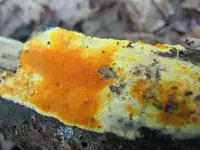
Ceriporia spissa is a crust-like wood-decay fungus rather than a leafy plant. It forms thin, spreading patches on dead or dying wood, often with a pale to cream surface. The texture is usually smooth to slightly bumpy, closely attached to the bark or exposed wood.
This species occurs mainly in temperate forests, where it plays an important role in breaking down lignin and cellulose in fallen branches and logs. It is not commonly cultivated, and attempts to care for Ceriporia spissa at home are experimental, since it needs consistently moist, shaded wood and stable outdoor-like conditions.

Care Difficulty
Moderate Care

Light Preference
Partial Shade

Water Requirements
Regular Water

Temperature Preference
Warm Climate

Hardiness Zone
Unknown

Soil Texture
Loamy, Organic-rich

Soil pH
Slightly acidic (6.5–7.0)

Soil Drainage
Moist but well-drained

Fertilization
Minimal (feed rarely)
Scan your plant to receive care tips personalized for your specific plant
Available on iOS and Android
This wood-decay fungus prefers low to moderate natural light typical of shaded forest habitats.
This species thrives on consistently moist, decaying wood rather than direct soil watering.
This fungus is adapted to cool to mild woodland conditions and avoids temperature extremes.
Humidity is not a major concern for Ceriporia spissa, which naturally colonizes dead wood in variable outdoor conditions.
Ceriporia spissa grows on dead wood rather than in conventional mineral soil, so focus on wood-based substrate rather than potting soil.
This species is not well suited to conventional container growing because it is a wood-decaying fungus dependent on solid woody substrates rather than potting media.
This wood-decay fungus typically requires no additional nutrients when growing on suitable dead wood in natural or managed settings.
Pruning is not applicable to Ceriporia spissa, as it is a crust fungus that naturally colonizes and decomposes dead wood without structural shaping.
Transplanting is generally unnecessary, since this crust fungus is managed by providing suitable wood rather than moving established colonies.
Propagation of this crust fungus is usually left to natural spore dispersal and colonization processes rather than active horticultural techniques.
No special winter care is needed, as this wood-inhabiting fungus tolerates normal outdoor seasonal changes on deadwood in its suitable climate range.

Plant Health Check
Not sure what's wrong with your plant? Check your plant's health inside the app.
The fruiting bodies of this crust fungus form a thin, whitish to cream layer with small, angular pores whose edges can appear slightly waxy or translucent when fresh, a feature used to separate it from similar Ceriporia species.
This species causes white rot in dead hardwood, selectively breaking down lignin and leaving behind pale, fibrous wood, which accelerates nutrient recycling in temperate forest ecosystems.
It is distinguished microscopically by its narrowly cylindrical spores and characteristic cystidia-like sterile elements in the hymenium, which mycologists rely on for reliable identification in the Ceriporia genus.
This crust fungus expands slowly to moderately, usually forming visible patches over several weeks to a few months on fallen logs. Growth rate depends strongly on wood moisture, temperature, and how recently the wood was colonized by other fungi.
Keep your plants happy and healthy with plant identification, disease detection, and easy care guidance.

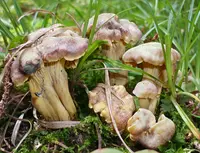
amethyst chanterelle
Cantharellus amethysteus
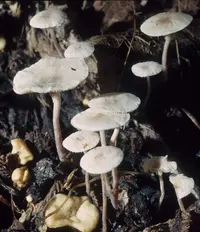
Splitpea Shanklet
Collybia cookei
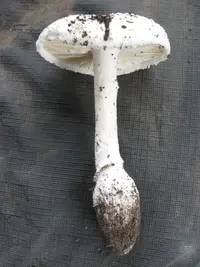
Australian Flour Lepidella
Amanita farinacea
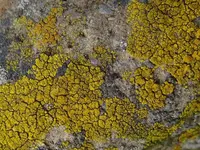
eggyolk lichen
Candelariella vitellina
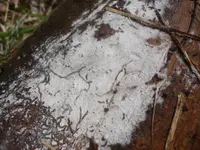
Botryobasidium subcoronatum
Botryobasidium subcoronatum
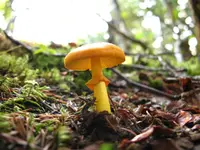
Peck's Yellow Dust Amanita
Amanita elongata
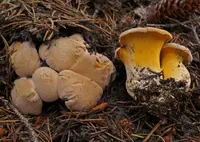
Rainbow Chanterelle
Cantharellus roseocanus
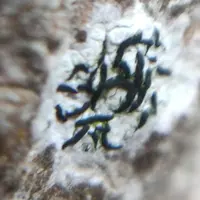
Worm Lichen
Alyxoria culmigena