Ceropegia aristolochioides Care

About Ceropegia aristolochioides

Ceropegia aristolochioides is a small, twining succulent vine known for its unusual lantern-shaped flowers and slender, often trailing stems. It belongs to the Apocynaceae family, the same group as many stapeliads and hoyas. This species is native to parts of East Africa, where it grows in rocky, well-drained habitats with seasonal rainfall. It stores water in its tissues, which makes it more forgiving of short dry periods but sensitive to prolonged wet soil. When learning how to care for Ceropegia aristolochioides, it helps to treat it like a delicate succulent: bright light, airy soil, and careful watering support healthy, compact growth indoors.

Main Plant Requirements

Care Difficulty

Moderate Care

Light Preference

Bright Indirect Light

Water Requirements

Low Water

Temperature Preference

Tropical / Frost Sensitive

Hardiness Zone

11–12

Soil Texture

Sandy, Loamy, Rocky

Soil pH

Acidic (5.5–6.5), Slightly acidic (6.5–7.0)

Soil Drainage

Well-drained

Fertilization

Minimal (feed rarely)

Get Personalized Care Plan

Scan your plant to receive care tips personalized for your specific plant

Available on iOS and Android

How to Care for the Ceropegia aristolochioides

This species prefers bright conditions with protection from harsh midday sun.

  • Provide 4–6 hours of bright, indirect light or gentle morning sun; light shade at midday helps prevent leaf scorch, especially in hot climates.
  • Tolerates light partial shade, but stems may stretch and flowering may decline if grown in less than 3–4 hours of bright light.
  • Outdoors, position where it gets early sun and dappled afternoon light; in winter, move Ceropegia aristolochioides to the brightest frost-free spot available.

This succulent climber stores moisture in its tissues and prefers infrequent, thorough watering.

  • Allow the top 3–5 cm of soil to dry before watering again; in warm active growth this may mean watering every 7–14 days depending on climate and soil.
  • Use sharply drained, gritty soil so excess water runs out quickly; constantly wet or heavy soil encourages root rot and yellowing, mushy stems.
  • In cooler months reduce watering markedly, only when the pot feels very light and leaves begin to slightly soften or wrinkle, signaling mild thirst.

This plant prefers warm, stable conditions and is sensitive to frost.

  • Aim for 65–80°F (18–27°C) during active growth, which supports steady vine and root development without stress.
  • Protect from temperatures below 50°F (10°C); brief dips to 40–45°F (4–7°C) may be survived but can slow growth and risk tissue damage.
  • In hot spells above 90°F (32°C), provide shade and good air movement to limit heat stress, and avoid sudden swings between day and night temperatures.

This species handles typical indoor humidity but benefits from slightly drier air than many tropicals.

  • Aim for 30–50% humidity, similar to an average heated home, without extra humidification.
  • Dry air is usually tolerated, but combined with high heat it can lead to limp, wrinkling leaves and stalled growth.
  • Increase humidity slightly by grouping plants or placing the pot above, not in, a pebble tray with water if tips shrivel.

Soil for Ceropegia aristolochioides should be fast-draining, airy, and only lightly organic.

  • Use a cactus/succulent base mix amended with extra perlite or pumice and a small amount of fine bark for structure.
  • Aim for a loose, sandy or gritty texture that drains in seconds yet holds a thin film of moisture around the roots.
  • Target a slightly acidic to neutral pH around 6.0–7.0, which suits most commercial succulent mixes.
  • Avoid dense peat-heavy or clayey substrates that stay wet, collapse, and restrict aeration around the tubers.

This species is very suitable for container growing due to its compact tuberous root system.

  • Choose a pot only 2–4 cm wider than the root mass so the mix dries evenly between waterings.
  • Select unglazed terracotta if extra evaporation is needed in humid or cool homes to prevent prolonged wetness.
  • Use a stable, heavier pot or wide base if vines are trained on a support to prevent the container from tipping over.

This species benefits from light, controlled feeding rather than heavy fertilizer use.

  • Use a dilute balanced liquid fertilizer (around 10-10-10 or 20-20-20 at 1/4–1/2 strength) during active growth.
  • Apply every 4–6 weeks in spring and summer when Ceropegia aristolochioides is actively vining.
  • Skip fertilizer in late fall and winter, or feed at most once at very weak strength.
  • Avoid compost-heavy mixes or slow-release pellets that can keep soil too rich or moist for the roots.

Pruning is mainly used to tidy growth and manage the vine’s length.

  • Best time is late winter or early spring before strong new growth starts.
  • Use clean, sharp scissors or small pruning shears to remove dead, yellowing, or damaged stems.
  • Shorten overly long or tangled vines to encourage branching and a fuller hanging form.
  • Limit cuts to healthy tissue only, and avoid removing more than 1/3 of total growth at once.

This plant prefers slightly tight quarters and only occasional repotting.

  • Check for roots circling the pot, pushing through drainage holes, or for unexplained slowing of growth.
  • Plan to repot every 2–3 years in late winter or early spring, just before new growth begins.
  • Move to a pot only 2–3 cm wider, using a free-draining succulent or cactus mix to limit waterlogging stress.
  • Handle tubers and roots gently, keep them at the same depth, water lightly after repotting, and shade from strong sun for 3–5 days.

Propagation is commonly done from stem cuttings and tubers rather than seed.

  • Take 1–2 node stem cuttings in spring or early summer, including at least one leaf per node.
  • Lay or plant nodes on a gritty, barely moist mix and keep at 70–80°F with bright, indirect light.
  • Allow cut ends to dry for a few hours before inserting into the substrate to reduce rot risk.
  • Tubers can be divided carefully, ensuring each piece has a growth point, then potted individually.

Winter care focuses on avoiding cold damage and excessive moisture around the roots.

  • Treat as frost-sensitive and keep above 50°F, ideally 60–75°F indoors in winter.
  • Bring outdoor containers inside before the first frost and place in bright, indirect light.
  • Reduce watering significantly in the cool season, letting most of the potting mix dry between light waterings.
  • Ensure good airflow and a dry, free-draining substrate to prevent rot during semi-dormancy.

Care Tips

Support trailing stems

Provide a low trellis, wire hoop, or horizontal mesh for the vines to weave through so the stems are less likely to kink, snap, or shade each other as they lengthen.

Encourage compact growth

Pinch back very long, bare sections of vine just above a node to stimulate branching and create a fuller plant with more flowering points over time.

Tuber health check

When repotting, gently unearth and inspect the tubers, discarding any that are soft or blackened and replanting only firm, healthy ones slightly above the soil line to reduce rot risk.

Seasonal rest adjustment

If growth slows markedly in cooler, darker months, reduce handling and avoid repotting or propagating, as the plant responds best to disturbance during its active growing phase.

Targeted mealybug control

Regularly inspect the leaf bases and stem nodes, then treat early mealybug infestations with a cotton swab dipped in isopropyl alcohol, repeating weekly until no new insects appear, which greatly simplifies caring for Ceropegia aristolochioides.

Common Pests and Diseases

Mealybugs

This pest hides in leaf nodes, on tender vines, and around the tubers, sucking sap and causing yellowing, stunted growth, and sticky honeydew deposits. Symptoms include cottony white clusters on stems, undersides of leaves, and sometimes on exposed roots or tubers in the potting mix.

Solution

Isolate the plant, then dab visible insects with cotton swabs dipped in 70% isopropyl alcohol and rinse the foliage and vines with lukewarm water. For heavier infestations, repeat alcohol spot-treatments weekly and use a systemic insecticide labeled for succulent vines, while also reducing excess nitrogen fertilization that encourages soft, mealybug-prone growth.

Spider mites

These insects thrive on Ceropegia vines in warm, dry indoor air, causing fine stippling on leaves, dull color, and eventual leaf drop. This pest often leaves fine webbing between the slender stems and around leaf nodes.

Solution

Shower the plant thoroughly, focusing on the undersides of leaves and vine joints, then increase humidity and improve air movement to make conditions less favorable to mites. For persistent colonies, use several rounds of insecticidal soap or horticultural oil at 5–7 day intervals, keeping the plant out of direct sun until the foliage is dry to prevent leaf burn.

Scale insects

These insects appear as small, hard or waxy bumps along stems and at nodes, where they suck sap and weaken the thin vines. Symptoms include slowed growth, yellowing leaves, and sticky honeydew that can attract sooty mold.

Solution

Gently scrape or remove individual scales with a fingernail or soft brush and wipe stems with a cloth lightly moistened with 70% isopropyl alcohol. For more extensive infestations, combine repeated manual removal with a systemic insecticide and check regularly along the trailing vines, where new crawlers often settle unnoticed.

Fusarium stem rot

This disease, favored by cool, poorly drained conditions, causes dark, sunken lesions on the thin succulent stems and can lead to sudden vine collapse. Symptoms include soft, discolored stem sections near the soil line and wilted segments above the affected area.

Solution

Remove and discard all affected vines and any obviously infected tubers, then repot in a fresh, sharply draining mix and a pot with large drainage holes. Improve airflow, avoid wetting the vines when watering, and allow the substrate to dry well between waterings to reduce reinfection, especially when growing Ceropegia aristolochioides indoors.

Bacterial leaf spot

This disease produces small, water-soaked spots on the fleshy leaves that may enlarge, turn dark, and sometimes develop a yellow halo. In humid, stagnant air these spots may coalesce, causing premature leaf drop on the delicate vines.

Solution

Promptly remove and discard affected leaves, avoid overhead watering, and water at the soil level to keep foliage dry. Increase air circulation, reduce crowding with nearby plants, and if spread continues, apply a copper-based bactericide according to label directions, monitoring new growth closely for fresh lesions.

Interesting Facts

Traplike flower design

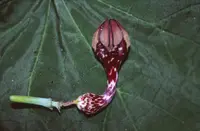
The tubular flowers form a cage-like structure with fused petals and downward-pointing hairs, temporarily trapping small flies so they contact the pollen as they move inside the floral tube.

Fly-deceiving scent

Its flowers emit a subtle odor that mimics the scent cues of decaying organic material, attracting specific fly pollinators that expect a breeding or feeding site but instead serve as pollinators.

Paired, spindle-shaped tubers

This species forms distinctive, often paired, spindle-shaped underground tubers that act as storage organs, allowing the plant to withstand dry periods in its native habitats.

Botan icon

Did you know?

This species shows geoflory in some populations, with flowers that can develop very close to the ground surface, positioning the intricate floral traps right in the flight path of low-flying dipteran pollinators that it relies on for successful reproduction.

FAQs about Ceropegia aristolochioides

This species produces long, twining vines that naturally climb or trail rather than form an upright shrub. It will wrap around nearby supports, or spill and cascade when grown in hanging baskets or elevated containers.

Grow Healthy Plants with Botan Care

Keep your plants happy and healthy with plant identification, disease detection, and easy care guidance.

Botan plant care app — identify plants on mobile

Explore More Plants