Trunk anchoring
Stake young palms with 2–3 soft ties to sturdy posts set outside the root zone for the first 1–2 years in windy sites, then remove once the trunk has thickened and fronds hold upright without movement.

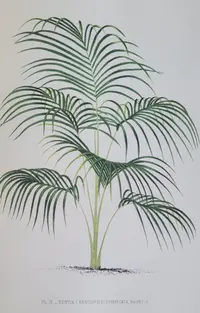
Chambeyronia divaricata, often called the red leaf palm or flame thrower palm, is a slow-growing, solitary feather palm. It is best known for its emerging fronds that open bright red before maturing to deep green, creating a striking contrast on the trunk.
This species is native to the humid forests of New Caledonia, where it grows under partial shade with consistently moist but well-drained soil. It prefers warm, frost-free conditions and steady moisture, which influences how to care for Chambeyronia divaricata in gardens or large containers.
With patience, good drainage, and shelter from harsh wind or strong sun, it can be a durable feature palm in suitable climates or protected outdoor spaces.

Care Difficulty
Moderate Care

Light Preference
Partial Shade

Water Requirements
Regular Water

Temperature Preference
Tropical / Frost Sensitive

Hardiness Zone
10–11

Soil Texture
Loamy, Sandy, Organic-rich

Soil pH
Acidic (5.5–6.5), Slightly acidic (6.5–7.0)

Soil Drainage
Moist but well-drained

Fertilization
Light (every 4–6 weeks)
Scan your plant to receive care tips personalized for your specific plant
Available on iOS and Android
This palm prefers bright, gentle light that mimics a high-canopy tropical forest.
This species prefers evenly moist, well-drained soil rather than cycles of full drying or saturation.
This palm grows best in warm, stable conditions without frost or extreme heat spikes.
This palm prefers consistently moist air and reacts clearly to very dry conditions.
This palm performs best in deep, moist, well-aerated soil that drains freely but does not dry out quickly.
This slow-growing palm is suitable for long-term container culture, especially in cooler climates.
This palm benefits from light, steady feeding to support slow, healthy growth.
Pruning needs for this palm are minimal and focus on health rather than shaping.
Transplanting or shifting this slow-growing palm is infrequent but must be done carefully to protect the roots.
This species is usually propagated from seed and is considered slow and specialized for home growers, so propagation is rarely attempted.
This palm is frost-sensitive and needs thoughtful winter care in climates cooler than its tropical native range.

Plant Health Check
Not sure what's wrong with your plant? Check your plant's health inside the app.
This palm is naturally restricted to New Caledonia, where it grows in lowland to mid‑elevation rainforests on ultramafic and other mineral‑rich soils, making it a true regional endemic with a narrow native range.
Its famous bright red emerging leaves are a transient juvenile stage that quickly mature to green, likely acting as a visual signal to herbivores that the leaf tissue is still tender and chemically defended.
The species develops a prominent, smooth crownshaft that can show shades of green, yellow‑green, or even slightly orange, which helps distinguish it from related species with different crownshaft coloration and proportions.

This species is dioecious, meaning individual palms bear either male or female flowers but not both, so successful seed production in cultivation requires genetically distinct male and female plants growing within pollination distance.
This palm grows slowly, usually adding 15–30 cm of trunk per year in warm climates. Growth is slower in containers or cooler areas. Consistent moisture, warmth, and regular feeding can noticeably improve vigor and speed.
Keep your plants happy and healthy with plant identification, disease detection, and easy care guidance.