Deep rooting support
Stake young plants loosely on the windward side for the first 1–2 years to keep the stem stable while the deep taproot system establishes properly in sandy soils.

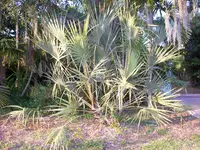
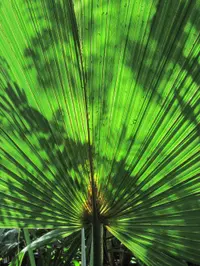
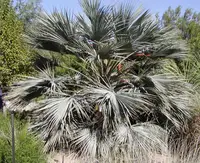
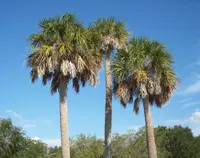
The Ilala palm, Hyphaene coriacea, is a robust, multi-stemmed fan palm native to coastal and lowland regions of eastern and southern Africa. It often forms clumps with several tall, slender trunks topped by stiff, blue-green fan-shaped leaves.
In its natural habitat it grows in sandy soils and open, sunny areas, sometimes near seasonal watercourses. The plant is slow to moderate in growth and can be long-lived.
Thick, fibrous leaves and a strong root system give it good drought tolerance once established, but young plants need consistent moisture and free-draining soil. Understanding how to care for Ilala palm is important, as it dislikes waterlogging and deep shade, which can weaken growth over time.

Care Difficulty
Moderate Care

Light Preference
Full Sun

Water Requirements
Moderate Water

Temperature Preference
Warm Climate

Hardiness Zone
10–12

Soil Texture
Sandy, Loamy

Soil pH
Slightly acidic (6.5–7.0), Neutral (7.0)

Soil Drainage
Well-drained

Fertilization
Minimal (feed rarely)
Scan your plant to receive care tips personalized for your specific plant
Available on iOS and Android
Hyphaene coriacea prefers strong sun typical of its native savanna habitats.
Watering for Hyphaene coriacea should mimic a dry, seasonal climate with occasional deeper soakings.
This palm thrives in warm to hot climates with mild winters and strong seasonal sun.
Humidity is not a major factor for Hyphaene coriacea if basic indoor levels are maintained.
Hyphaene coriacea favors lean, fast-draining, sandy substrates that mimic coastal or dry savanna conditions.
This palm can be grown in containers, but only with attention to stability and rapid drainage.
Hyphaene coriacea grows slowly and needs only modest feeding in cultivation.
Pruning Hyphaene coriacea is mainly hygienic rather than shaping.
Hyphaene coriacea is usually grown in-ground, with transplanting done sparingly and carefully.
Propagation of Hyphaene coriacea is possible but slow and mainly done from seed.
Hyphaene coriacea prefers warm climates and has limited frost tolerance.

Plant Health Check
Not sure what's wrong with your plant? Check your plant's health inside the app.
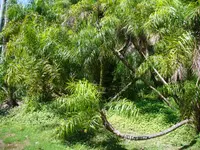
This palm often develops a noticeably forked trunk as it matures, a branching habit that is unusual among palms, which are typically single-stemmed.
It is naturally adapted to coastal dune systems in southeast Africa, where it stabilizes sandy soils with an extensive root system and tolerates salt-laden winds.
The tree produces hard, orange-brown fruits with a fibrous, edible mesocarp, and in some regions its sap is tapped and fermented as a traditional palm wine.

In parts of southern Africa, this species is one of the main sources of durable leaf fiber for weaving hats, mats, and baskets, forming the basis of long-established local craft traditions and small-scale economies.
Yes, this species can be grown from fresh seed, but germination is slow and irregular, often taking several months. Remove fruit pulp, soak seeds, then sow in deep containers with well-drained sand-based mix and steady warmth.
Keep your plants happy and healthy with plant identification, disease detection, and easy care guidance.