

Shaggy Parasol Identification (Chlorophyllum rhacodes)

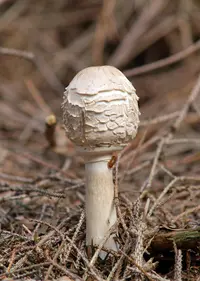
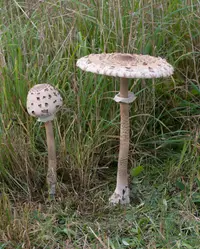
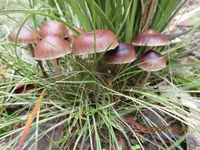
Recognize Chlorophyllum rhacodes by its broad cap covered with coarse brown scales on a pale background, a thick stalk with a distinct ring, and crowded white gills that are free from the stalk.

It usually grows as a single, upright mushroom with a cap several inches across and a proportionally stout stem.

Chlorophyllum rhacodes Identification

Scan to Confirm Shaggy Parasol

Take a photo and use Botan to confirm your plant identification.

Clear images work best. Avoid photos taken too close or too far away

Check the cap, stem, and gills for a few easy field marks.

  • Cap starts egg-shaped, then opens broad and convex to nearly flat, often 4-8 inches (10-20 cm) across.
  • Cap surface breaks into coarse, shaggy brown scales over a paler background, especially toward the center.
  • Gills are crowded, free from the stem, and white to cream, ending just before they touch the stalk.
  • Stem is tall and fairly stout with a swollen base and a loose, movable ring around the upper part.

Bruising or cut flesh often shows orange to reddish-brown staining.

Chlorophyllum rhacodes shows clear visual shifts as the fruiting body expands and ages.

  • Young plant: It begins as a rounded button, with the cap still closed and the stem short, so the shaggy cap surface is only partly visible.
  • Mature plant: The cap opens broadly to about 4-8 inches (10-20 cm), revealing coarse brown scales over a pale background and a taller, more distinct stem.
  • Flowering stage: Gills become fully exposed beneath the expanded cap, starting pale and crowded, while the partial veil tears and leaves a visible ring on the stem.
  • Fruiting stage: With age, the cap flattens further, scales often lift more clearly, and the gills darken from pale to deeper tones as the mushroom releases spores.

Chlorophyllum rhacodes is most noticeable from late summer into fall, when the fruiting body pushes up from the ground and opens quickly into a broad, shaggy-scaled cap. This is the clearest seasonal identification cue. Outside the fruiting period, little remains visible above ground. In winter or dry stretches, it is usually absent from view rather than showing persistent stems, leaves, or woody parts.

Several parasol mushrooms can be mistaken for Chlorophyllum rhacodes.

green-spored parasol(Chlorophyllum molybdites)

Similar cap size and shaggy scales can mislead. Check the gills and spore print: mature gills turn gray-green, and the spore print is green, not white.

parasol mushroom(Macrolepiota procera)

Both are tall, broad parasol-shaped mushrooms with a ring. Macrolepiota procera usually has a slimmer stem with a distinct snakeskin pattern and a less bulbous base.

false shaggy parasol(Chlorophyllum brunneum)

Often confused because the cap is similarly brown and scaly. It is usually stockier, with a more abruptly bulbous stem base and a ring that is less freely movable.

Chlorophyllum rhacodes is native to Europe and is widely reported from temperate parts of the continent. It typically appears in rich soil in woodland edges, gardens, composty ground, and other disturbed sites. Habitat can help with identification because this species often fruits in human-influenced places rather than deep forest. Finding it in mulch, garden beds, or at path edges can help narrow the ID.

  • Misidentification risk: This mushroom has a serious ingestion risk because it can be confused with poisonous white-spored parasol mushrooms, especially Amanita species, for humans and pets.
  • Key separating feature: A useful check is the spore print: Chlorophyllum rhacodes has a white spore print, so this alone does not rule out Amanita. The bulbous base and volva, a cup-like sac at the stem base, are important danger signs of Amanita.

Confirm It from a Photo

Use Botan to identify or double-check a plant from a photo, helping avoid mix-ups with similar-looking species.

FAQ

Look for a large, parasol-shaped mushroom with a cap covered in shaggy brown scales over a paler background, free white gills, and a stout stem with a movable ring. The flesh often stains orange-red when cut.

More Plant Identification Guides

One Photo. More About Your Plant.

Identify a plant from a photo with Botan, then see its profile, care information, and common problems.

Botan app identifying a plant from a photo
Top 15 Fast-Growing Trees For Your Garden

13 min read · 28 Jul 2026

Top 15 Fast-Growing Trees For Your Garden

Learn which of the 15 fastest-growing trees will suit your area. We’ll share detailed information on each: growth rate, mature spread, key tree demands, and main vulnerabilities. Read on and make the best choice possible.

Plant Recommendations
Top 15 Fast-Growing Trees For Your Garden
How to Mulch in the Fall and When to Wait Until Spring

5 min read · 12 Nov 2026

How to Mulch in the Fall and When to Wait Until Spring

In the fall, mulch gives the roots of trees and shrubs insulation and more stable conditions through winter. In the spring, it mainly suppresses weeds and keeps moisture in the soil during the growing season.

Beginner Guides
How to Mulch in the Fall and When to Wait Until Spring
Best Time to Water Grass in Summer – Lawn Watering Tips

5 min read · 21 Jul 2026

Best Time to Water Grass in Summer – Lawn Watering Tips

Summer watering is easy to get wrong. This guide explains when to turn on your sprinkler, how much liquid your grass needs each week, and how to tell if you're overwatering or underwatering.

Plant Care
Best Time to Water Grass in Summer – Lawn Watering Tips