Choose stable substrates
Attach the lichen to long-lasting, slightly rough surfaces like old hardwood, natural stone, or unglazed clay, since loose or crumbly materials break down and cause the thallus to detach over time.

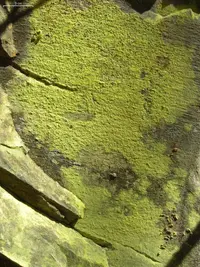
Dust lichen (Chrysothrix chlorina) is a crustose lichen, not a true plant, forming fine, bright yellow to yellow‑green powdery mats on bark and rock. It has a dust-like surface texture and usually grows in irregular patches that can merge into larger cushions over time.
This species occurs mainly in temperate and boreal regions, often in moist forests with clean air, since many lichens are sensitive to pollution. It is slow-growing and relies on stable, humid microclimates, which makes it challenging to keep in typical home conditions.
Those who want to care for dust lichen should provide cool, shaded conditions, steady moisture in the air, and a stable, low-nutrient surface rather than regular potting soil.

Care Difficulty
Hard Care

Light Preference
Partial Shade

Water Requirements
Low Water

Temperature Preference
Cool Climate

Hardiness Zone
Unknown

Soil Texture
Rocky, Sandy

Soil pH
Acidic (5.5–6.5)

Soil Drainage
Well-drained

Fertilization
Minimal (feed rarely)
Scan your plant to receive care tips personalized for your specific plant
Available on iOS and Android
Chrysothrix chlorina prefers bright, indirect light and is usually found on shaded rock or bark surfaces.
This lichen absorbs moisture mainly from rain, mist, and humid air rather than from soil.
This species tolerates a broad temperature range but grows most actively in cool to mild conditions.
This lichen prefers moderately moist air but tolerates short dry periods if its substrate does not desiccate completely.
Chrysothrix chlorina grows on firm, stable, low-organic substrates rather than conventional potting soil.
This species can be maintained in shallow containers that simulate a rocky or bark-like surface rather than typical pot culture.
Chrysothrix chlorina, a lichen, gains nutrients mainly from rain, dust, and its substrate, so added fertilizer is generally unnecessary and can be harmful.
Pruning needs for Chrysothrix chlorina are minimal and focus on maintaining its substrate rather than reshaping the lichen itself.
Transplanting Chrysothrix chlorina is rarely necessary and often stressful, so it is usually left undisturbed on its natural substrate.
Deliberate propagation of Chrysothrix chlorina is slow, specialized, and rarely attempted outside research or conservation work.
This lichen is naturally cold hardy in its range and does not require active winter care under normal outdoor conditions.

Plant Health Check
Not sure what's wrong with your plant? Check your plant's health inside the app.
This lichen forms a loose, powdery layer of intense yellow to yellow‑green granules on rock surfaces rather than a flat leafy or crusty body, which is why it is often called dust lichen.
Populations are often found on metal-rich substrates such as old mines, slag, or polluted rocks, indicating a natural tolerance to elevated levels of heavy metals in the environment.
In some regions, its abundance has been linked to nitrogen-enriched habitats, so ecologists sometimes use it as a rough indicator of areas affected by airborne nitrogen compounds.
Growth is slow. The thallus usually expands only a few millimeters per year, depending on light, moisture, and air quality. Urban pollution or frequent disturbance can slow it further, so patience is important when growing this species.
Keep your plants happy and healthy with plant identification, disease detection, and easy care guidance.