Use Stable Substrate
Attach thalli only to long-lasting, inert substrates like unglazed rock, brick, or concrete rubble, because this crustose lichen bonds slowly and does poorly on loose or decomposing organic materials.

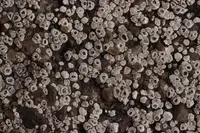
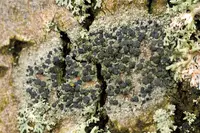
Chiseled sunken disk lichen, Circinaria contorta, is a crustose lichen, not a traditional plant. It forms tight, pale gray to whitish crusts that strongly adhere to rock surfaces. The surface often looks cracked or chiseled, with tiny sunken disks where reproductive structures develop.
This species is common on exposed, dry rocks in temperate and cold regions, including many parts of North America and Europe. It tolerates strong sun, temperature extremes, and low nutrients, which makes it hardy in nature but slow-growing. For those who want to care for Chiseled Sunken Disk Lichen under controlled conditions, it generally prefers clean air, stable rock substrates, and good air movement rather than rich soil or frequent watering.

Care Difficulty
Moderate Care

Light Preference
Full Sun

Water Requirements
Low Water

Temperature Preference
Cold Hardy

Hardiness Zone
3–9

Soil Texture
Rocky, Sandy

Soil pH
Neutral (7.0), Slightly alkaline (7.0–7.5)

Soil Drainage
Well-drained

Fertilization
Minimal (feed rarely)
Scan your plant to receive care tips personalized for your specific plant
Available on iOS and Android
This crustose lichen thrives in high light and open, exposed sites.
This rock-dwelling lichen is highly drought-tolerant and relies on brief wetting rather than sustained moisture.
This lichen is adapted to wide outdoor temperature swings on exposed rock.
This crustose lichen thrives in open, dry sites where air humidity stays low to moderate.
Circinaria contorta naturally colonizes bare rock or mineral-rich, highly drained substrates rather than true soil.
This lichen can be grown in shallow containers or rock trays that mimic exposed stone surfaces.
Circinaria contorta, or Chiseled Sunken Disk Lichen, does not need fertilization under normal conditions and obtains nutrients from rainwater, dust, and its substrate.
Pruning Circinaria contorta is generally unnecessary and mainly done for safety or aesthetic reasons on host surfaces such as rocks, roofs, or tree bark.
Transplanting Circinaria contorta is rarely needed and can be stressful, so it is usually left undisturbed on its original substrate.
Propagation of Circinaria contorta is slow and specialized, so it is not typically attempted by home growers.
Circinaria contorta is very cold hardy and usually requires no special winter care in outdoor conditions across its range.

Plant Health Check
Not sure what's wrong with your plant? Check your plant's health inside the app.
This lichen strongly favors calcareous substrates such as limestone, mortar, and concrete, forming tightly attached crusts that can tolerate high pH and exposed conditions.
Its thallus breaks into pale, angular plates called areoles that often look chiseled or cracked, creating the characteristic pattern that led to the common name chiseled sunken disk lichen.
Populations occur from lowland urban walls to exposed upland and coastal rocks, showing high tolerance to temperature fluctuations, strong sunlight, and periodic drying.

Circinaria contorta has been used in biomonitoring studies because its presence and condition on stone surfaces can indicate long-term changes in air quality and atmospheric pollution in built and natural environments.
Growth is very slow. Crustose lichens typically expand only a few millimeters per year, depending on moisture, light, and air quality. Stable, undisturbed rock surfaces and clean air help this species establish and grow Circinaria contorta steadily over decades.
Keep your plants happy and healthy with plant identification, disease detection, and easy care guidance.