

Creeping Thistle Identification (Cirsium arvense)

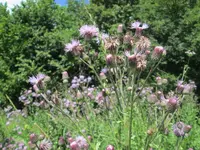
Recognize Creeping Thistle by its creeping colony growth, narrow alternate leaves with sharply spiny lobes, and wingless stems that branch near the top.

Flower heads are small, about 1/2 to 3/4 inch (1.3 to 2 cm) wide, clustered, and lack the large spiny bracts seen on many other thistles.

Cirsium arvense Identification

Identify Your Plant with Botan

Use a clear photo to confirm what plant you have.

Clear images work best. Avoid photos taken too close or too far away

Check the plant’s spiny leaves, wingless stems, and small thistle heads.

  • Leaves are alternate, narrow to oblong, deeply lobed, and edged with many short sharp spines.
  • Upper leaf surfaces are green; the undersides are usually paler and may look slightly hairy.
  • Stems are upright, branching near the top, and lack the continuous spiny wings seen on some thistles.
  • Flower heads are small, about 1/2 to 3/4 inch (1.3 to 2 cm) wide, clustered at stem tips, and usually purple-pink.

Look for several stems forming a dense patch rather than a single isolated plant.

Creeping Thistle shows clear visual changes from low rosettes to branched flowering stems.

  • Juvenile plant: Begins as a basal rosette close to the ground, with narrow, deeply lobed leaves and sharp marginal spines; no obvious upright stem yet.
  • Mature plant: Forms erect, grooved stems 2-5 feet (0.6-1.5 m) tall, with alternate, clasping leaves that become smaller upward and branching concentrated near the top.
  • Flowering stage: Stem tips and upper branches carry clustered purple flower heads; the plant looks more open above, with leafless stalks lifting heads beyond the foliage.
  • Fruiting stage: After flowering, heads turn cottony as white pappus emerges, giving a softer, tufted look unlike the compact buds and dense flower heads.

In spring, Cirsium arvense sends up new shoots from spreading roots. Early leaves appear narrow and spiny-edged, then stems lengthen into upright patches that become easier to spot by early summer. Flower heads are usually most visible in summer, followed by fluffy white seed tufts that stand out as heads open. After frost, the top growth dies back, leaving dried, pale stems and spent heads before winter disappearance.

A few spiny weeds are regularly mistaken for Creeping Thistle.

bull thistle(Cirsium vulgare)

Confusion happens because both are purple-flowered thistles with prickly, lobed leaves. Bull thistle usually has a single stout stem and larger flower heads, often 1 to 2 inches (2.5 to 5 cm) wide. Cirsium arvense has smaller heads in clusters and spreads by creeping roots.

Canada thistle(Carduus nutans)

Both can form spiny patches with purple heads. Musk thistle is taller, often 3 to 6 feet (0.9 to 1.8 m), with fewer but much larger nodding flower heads. Creeping thistle has upright, smaller heads and colony-forming growth.

Cirsium arvense is native to much of Europe and temperate Asia. Its original habitats include meadows, riverbanks, open woodland edges, and disturbed grasslands. That range matters because a thistle in these Eurasian settings may be native, while similar plants in North America are often introduced. Habitat also helps narrow identification. This species is especially common in sunny, disturbed places such as pastures, roadsides, field margins, and waste ground rather than shaded forest or wetlands.

  • Spines: Sharp spines on the leaf margins and stems can puncture skin on contact. This is a handling risk for humans and pets rather than an ingestion hazard.
  • Dense patches: Large colonies can hide the spiny stems and leaves, increasing the chance of accidental skin injury to people and animals moving through them.

Not Sure About the ID?

Use Botan to compare a photo and help verify the plant before spending more time on research.

FAQ

The seeds are small, dry, one-seeded fruits called achenes. They are brown to straw-colored and topped with a white, feathery pappus that helps them blow in the wind.

More Plant Identification Guides

Scan Your Plant. Get the Details.

Identify a plant from a photo with Botan, then see species-specific plant details, care information, and common problems.

Botan app identifying a plant from a photo
How To Revive a Dying Plant: 6 Steps To Bring A Plant Back To Life

6 min read · 1 Sept 2026

How To Revive a Dying Plant: 6 Steps To Bring A Plant Back To Life

Drooping leaves and brown tips don't always mean the end, and a weakened plant can often recover with a little help. These six simple steps will help you revive a dying plant and restore its health.

Plant Care
How To Revive a Dying Plant: 6 Steps To Bring A Plant Back To Life
Best Fertilizer for Grass in Summer: How to Choose the Right One

6 min read · 18 Aug 2026

Best Fertilizer for Grass in Summer: How to Choose the Right One

The right fertilizer in summer can make a lawn thrive. The wrong one can damage it. Here, you’ll learn the best NPK ratios by grass type, when and how to apply your formula, and how to recognize the signs of over- or under-fertilizing.

Plant Care
Best Fertilizer for Grass in Summer: How to Choose the Right One
Best Time to Water Grass in Summer – Lawn Watering Tips

5 min read · 21 Jul 2026

Best Time to Water Grass in Summer – Lawn Watering Tips

Summer watering is easy to get wrong. This guide explains when to turn on your sprinkler, how much liquid your grass needs each week, and how to tell if you're overwatering or underwatering.

Plant Care
Best Time to Water Grass in Summer – Lawn Watering Tips