Install sturdy staking
Place a firm stake on the windward side early in the season and loosely tie stems with soft ties to prevent lodging in wet, exposed sites.

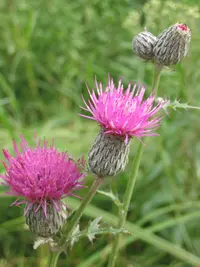
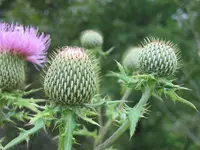
Swamp thistle (Cirsium muticum) is a native North American perennial herb found in wetlands, fens, and moist meadows. It forms upright clumps with sturdy, ridged stems and spiny, lobed leaves.
The plant produces rounded, soft-looking purple flower heads that attract bees, butterflies, and other pollinators. Its appearance is more refined and less aggressively spreading than some weedy thistles.
It naturally occurs in consistently moist, organic-rich soils and full sun to light shade. Once its needs are understood, it is moderately easy to care for swamp thistle in suitable garden wetland or rain garden conditions.

Care Difficulty
Moderate Care

Light Preference
Full Sun

Water Requirements
Keep Soil Moist

Temperature Preference
Cold Hardy

Hardiness Zone
3–7

Soil Texture
Loamy, Silty, Organic-rich

Soil pH
Acidic (5.5–6.5), Slightly acidic (6.5–7.0)

Soil Drainage
Waterlogged tolerant

Fertilization
Minimal (feed rarely)
Scan your plant to receive care tips personalized for your specific plant
Available on iOS and Android
This wetland perennial needs consistent light but tolerates some shade in natural settings.
This species prefers constantly moist conditions that mimic marshes and wet meadows.
This hardy perennial thrives in temperate climates with cool to warm summers and cold winters.
Humidity is not a major concern for Cirsium muticum, which is adapted to moist, open habitats.
Cirsium muticum grows best in consistently moist, oxygenated soil with high organic content.
This species can be grown in containers, but only where large, heavy pots can stay evenly moist.
Cirsium muticum is a native wetland perennial that needs only light feeding in most garden soils.
Pruning Cirsium muticum is mainly done to manage size, remove damage, and limit self-seeding.
This species is usually grown in-ground, so focus on careful transplanting rather than frequent repotting.
Cirsium muticum is most often propagated from seed, with some potential for division of younger clumps.
This hardy wetland thistle tolerates typical winters in much of its range and generally needs minimal winter care.

Plant Health Check
Not sure what's wrong with your plant? Check your plant's health inside the app.
Swamp thistle is a true wetland species, naturally occurring in fens, bogs, wet meadows, and swamps across eastern and central North America, where its deep root system helps stabilize saturated soils.
The stems are typically hollow and faintly grooved, an adaptation that reduces material investment while still providing enough support for the tall flowering stalks in soft, waterlogged ground.
Its nectar-rich purple flower heads attract a wide range of pollinators, including monarch butterflies and native bees, while the abundant seeds are a valued food source for finches and other seed-eating birds.

Unlike many other thistles introduced from Europe, swamp thistle is a native species that is often recommended in ecological restoration projects to support pollinators and wetland bird communities without the invasive tendencies associated with non-native thistles.
This species self-seeds readily and can form loose colonies, especially in consistently moist ground. Remove spent flower heads before seeds mature if spread is unwanted, and thin out young rosettes annually to keep colonies contained.
Keep your plants happy and healthy with plant identification, disease detection, and easy care guidance.