Self-seeding management
Mark preferred patches during peak bloom and lightly rake or disturb the soil surface there after seed drop to help seeds make contact with the soil while removing unwanted seedlings from paths and beds by shallow hoeing.

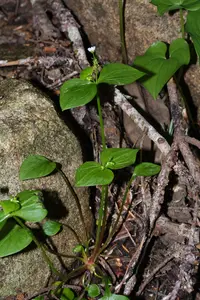
Siberian springbeauty, Claytonia sibirica, is a small, herbaceous perennial often used as a groundcover in cool, moist, shaded gardens. It forms low mats of succulent, bright green foliage.
The plant produces delicate, pink to white, star-shaped flowers with fine darker veins, typically blooming in spring and early summer. It often self-seeds and can spread where conditions are favorable.
Native to moist woodlands and stream edges in western North America and parts of northeastern Asia, it thrives in cool, damp, lightly shaded locations. Understanding how to care for Siberian springbeauty is mainly about providing consistent moisture, partial shade, and humus-rich soil so it does not dry out or overheat.

Care Difficulty
Easy Care

Light Preference
Partial Shade

Water Requirements
Keep Soil Moist

Temperature Preference
Cold Hardy

Hardiness Zone
4–8

Soil Texture
Loamy, Silty, Organic-rich

Soil pH
Acidic (5.5–6.5), Slightly acidic (6.5–7.0)

Soil Drainage
Moist but well-drained

Fertilization
Minimal (feed rarely)
Scan your plant to receive care tips personalized for your specific plant
Available on iOS and Android
This woodland perennial prefers cool, soft light rather than strong, direct sun.
This species prefers consistently moist, cool soil without becoming waterlogged.
This plant is naturally adapted to cool, mild woodland climates.
This woodland perennial prefers moderately moist air but adapts to typical indoor humidity.
Claytonia sibirica grows best in loose, humus-rich soil that stays evenly moist yet drains freely.
This species adapts well to container culture when moisture and drainage are carefully balanced.
This woodland perennial needs only modest feeding and often thrives in lean soil without extra fertilizer.
Claytonia sibirica needs minimal pruning, mainly to keep plantings tidy and limit spread.
This species is more often transplanted in the garden than grown as a long-term container plant.
Claytonia sibirica is commonly propagated by seed and by division of clumps.
Claytonia sibirica is cold hardy in much of its range and usually needs little winter care in the ground.

Plant Health Check
Not sure what's wrong with your plant? Check your plant's health inside the app.
This species is naturally found in cool, moist forests along the Pacific coast of North America and parts of northeastern Asia, often forming carpets on shaded, damp slopes and streambanks.
Its seeds bear small fatty attachments called elaiosomes, which attract ants that carry the seeds away, eat the fatty tissue, and leave the viable seeds to germinate in new microhabitats.
The plant behaves as a spring ephemeral in many sites, taking advantage of bright early-season light in deciduous woods, then often dying back or becoming sparse as canopy shade and soil dryness increase later in the year.

Genetic and morphological studies have shown that what was once treated broadly as Claytonia sibirica actually comprises several distinct but closely related lineages, and some populations historically lumped within this name have been reassigned to other species such as Claytonia serpenticola and Claytonia ogilviensis.
This species spreads by both seed and shallow rhizomes, forming loose carpets in suitable conditions. It is not usually aggressive, but in mild, moist climates it can naturalize widely and may need edging or thinning to stay contained.
Keep your plants happy and healthy with plant identification, disease detection, and easy care guidance.