Managed self-seeding
Allow a few seed heads to mature and drop in late summer, then thin the resulting seedlings in spring so only the strongest plants remain and dense patches do not crowd nearby perennials.

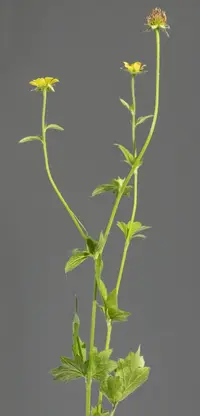
Wood avens (Geum urbanum) is a hardy, clump-forming perennial from the rose family, often found in woodland edges, hedgerows, and shaded gardens. It has coarse, toothed leaves at the base and slender stems carrying small, yellow, nodding flowers that later form distinctive burr-like seed heads.
The plant is adaptable, tolerating shade, average soils, and cool conditions, which makes it relatively easy to manage. It can self-seed and spread, so gardeners who care for Wood Avens may need to control unwanted seedlings.
In cultivation, it usually prefers partial shade, consistent moisture, and reasonably fertile, well-drained soil, but it also copes with less-than-ideal sites.

Care Difficulty
Easy Care

Light Preference
Partial Shade

Water Requirements
Moderate Water

Temperature Preference
Cold Hardy

Hardiness Zone
4–8

Soil Texture
Loamy, Silty, Organic-rich

Soil pH
Acidic (5.5–6.5), Slightly acidic (6.5–7.0)

Soil Drainage
Moist but well-drained

Fertilization
Minimal (feed rarely)
Scan your plant to receive care tips personalized for your specific plant
Available on iOS and Android
This woodland perennial prefers soft light rather than intense, all-day sun.
This species prefers consistently moist but not waterlogged soil.
This hardy perennial is adapted to cool to mild temperate climates.
Humidity is rarely a limiting factor for Geum urbanum, which adapts well to typical outdoor levels in temperate climates.
Geum urbanum prefers moist, well-aerated earth that never stays waterlogged.
This species is suitable for container growing outdoors if the pot is prepared to manage moisture and root spread.
This woodland perennial needs only modest feeding, especially in richer garden soils.
Thoughtful pruning keeps Geum urbanum tidy and supports longer flowering.
This species is usually grown in the ground, so focus on dividing and transplanting rather than frequent repotting.
Geum urbanum is commonly propagated by division or from seed, both suited to typical garden conditions.
This hardy perennial tolerates normal winters in much of the US and usually needs only minimal winter care.

Plant Health Check
Not sure what's wrong with your plant? Check your plant's health inside the app.
The fruit of this species forms small burrs with hooked bristles that readily cling to animal fur and clothing, helping the plant spread along woodland paths and hedgerows.
This plant is adapted to grow in relatively low light at woodland edges and under deciduous trees, often forming loose colonies in disturbed or nutrient-rich soils.
Geum urbanum naturally hybridizes with related species such as Geum rivale where their ranges overlap, producing intermediate plants that show mixed floral and leaf traits.

In historical European folklore and herbals, this species was sometimes hung near doorways or carried as a charm, largely because of its clove-like root scent, which was believed to ward off harmful influences rather than for its ornamental value.
Poor flowering is often linked to too much shade, nutrient-poor soil, or old, congested clumps. Divide mature plants every 3–4 years, remove spent stems, and ensure moderate fertility rather than very lean or very rich conditions.
Keep your plants happy and healthy with plant identification, disease detection, and easy care guidance.