Stabilize Tall Stems
Install discreet stakes or a rigid ring support early, then loosely tie the developing columns with soft ties so the heavy, later growth stays upright without kinking at the base.

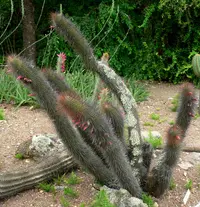
Old man of the mountain (Cleistocactus buchtienii) is a columnar cactus known for its tall, slender stems covered in dense, bristly spines that give a shaggy look. Mature plants can form clumps of upright stems that create a striking architectural shape in containers or outdoor cactus beds.
This species is native to high, dry regions of Bolivia, where it grows in rocky, well-drained soils with strong sunlight and cool nights. Its drought tolerance and slow growth make it relatively low maintenance, but it resents poor drainage and prolonged cold. Understanding how to care for old man of the mountain starts with bright light, infrequent watering, and a gritty, fast-draining cactus mix.

Care Difficulty
Easy Care

Light Preference
Full Sun

Water Requirements
Low Water

Temperature Preference
Tropical / Frost Sensitive

Hardiness Zone
10–11

Soil Texture
Sandy, Loamy, Rocky

Soil pH
Slightly acidic (6.5–7.0), Neutral (7.0)

Soil Drainage
Well-drained

Fertilization
Minimal (feed rarely)
Scan your plant to receive care tips personalized for your specific plant
Available on iOS and Android
Cleistocactus buchtienii prefers bright, prolonged sun that mimics high-altitude Andean conditions.
Watering for this cactus must stay on the dry side to avoid root and stem rot.
This species prefers warm, dry air with a marked cool season but poor frost tolerance.
This cactus tolerates a wide humidity range and rarely needs special humidity management indoors.
Use a very fast-draining, mineral-heavy mix to prevent root and stem rot.
This species is very suitable for container growing due to its columnar, relatively narrow habit.
This cactus benefits from light, controlled feeding during active growth but performs poorly if overfed.
Cleistocactus buchtienii needs minimal pruning, mainly to keep the plant healthy and structurally safe.
This cactus prefers staying slightly root bound and is repotted only when clearly necessary.
Propagation of this cactus is usually done from cuttings or seeds under warm, dry conditions.
This cactus is sensitive to prolonged freezing and needs thoughtful winter conditions, especially in containers.

Plant Health Check
Not sure what's wrong with your plant? Check your plant's health inside the app.
This species is native to semiarid inter-Andean valleys of Bolivia, where it grows on rocky slopes at moderate to high elevations with strong sun and marked day–night temperature swings.
Its stems are covered with closely spaced areoles that produce many long, fine, whitish spines and hairs, giving mature plants a noticeably shaggy, almost fuzzy appearance compared with many other columnar cacti.
It produces elongated, tubular red to orange-red flowers that project horizontally or slightly downward from the stems, an adaptation that helps attract hovering pollinators such as hummingbirds in its native range.

This cactus often forms multi-stemmed clumps over time, with numerous slender columns arising from the base, which in habitat can create dense, visually striking groups on exposed rocky outcrops.
Growth is moderate for a columnar cactus. In good conditions it typically adds about 5–15 cm per year, sometimes more when young. Growth slows with age, cool temperatures, low light, or after root disturbance.
Keep your plants happy and healthy with plant identification, disease detection, and easy care guidance.