


Choose host wood
Install this wood-decay fungus only on well-seasoned conifer logs or stumps (especially spruce or fir) that are off the ground to reduce competing fungi and improve colonization success.

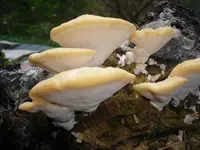
Climacocystis borealis is a wood-decay fungus, not a leafy houseplant. It forms thick, soft, shelf-like brackets with a pale, often creamy upper surface and a porous underside. These fruiting bodies usually appear in overlapping tiers.
This species typically grows on dead or weakened conifer wood in cool, moist forests across northern and montane regions of Europe, Asia, and North America. It plays an important ecological role by breaking down lignin and cellulose in wood.
Because it is a saprophytic fungus that relies on rotting timber, it is not practical to cultivate as a typical ornamental. Information on how to care for Climacocystis borealis is limited and it is generally left to grow in natural woodland conditions.

Care Difficulty
Moderate Care

Light Preference
Shade

Water Requirements
Keep Soil Moist

Temperature Preference
Cold Hardy

Hardiness Zone
3–7

Soil Texture
Loamy, Silty, Organic-rich

Soil pH
Acidic (5.5–6.5), Slightly acidic (6.5–7.0)

Soil Drainage
Moist but well-drained

Fertilization
Minimal (feed rarely)
Scan your plant to receive care tips personalized for your specific plant
Available on iOS and Android
This wood-decay fungus prefers cool, shaded forest conditions rather than direct open sun.
Moist, cool wood is essential for stable fruiting and mycelial health.
This fungus is adapted to cool, boreal and temperate forests with marked seasonal changes.
Humidity is not a significant factor for Climacocystis borealis, which naturally grows exposed on decaying conifer wood.
This wood-decay fungus does not grow in conventional soil but on dead conifer wood with specific structural conditions.
This species is generally unsuitable for container growing because it requires colonizable dead conifer wood rather than potting media.
This wood-decay fungus usually grows on nutrient-rich dead conifer wood and does not require added fertilizer in cultivation.
As a bracket fungus on dead or dying conifers, Climacocystis borealis is not managed with pruning like a typical garden plant.
Climacocystis borealis is not suited to standard pot culture, so care focuses on positioning inoculated wood rather than repotting.
This species is typically left to spread naturally, and deliberate propagation of Climacocystis borealis is uncommon outside specialist mycology work.
This fungus is naturally cold hardy across boreal and cool temperate climates and needs no special winter care in outdoor settings.

Plant Health Check
Not sure what's wrong with your plant? Check your plant's health inside the app.
This species is a brown-rot fungus that selectively breaks down cellulose and hemicellulose in conifer wood while leaving much of the lignin, creating a characteristic cubical, brittle decay.
It occurs most often on dead or weakened conifer trees, especially spruce and fir, and is much less frequent on broadleaf hosts, making it a useful indicator of conifer wood decay in boreal and montane forests.
The fruitbodies form overlapping, cushion-like brackets with a soft, spongy texture when fresh, which become tough and brittle as they age, a feature used by mycologists to distinguish it from similar polypores.

Molecular studies have shown that this species, once placed in the large catch-all genus Polyporus, is evolutionarily distinct enough to warrant its own separate genus, Climacocystis, making it the type and currently best-known representative of that genus.
This bracket fungus is sometimes reported as edible but is tough, fibrous, and considered of very poor culinary value. Identification mistakes with similar wood-decay fungi can be dangerous, so it is safer not to collect it for food.
Keep your plants happy and healthy with plant identification, disease detection, and easy care guidance.

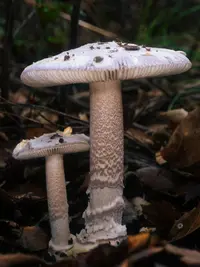
Protected Ringless Amanita
Amanita protecta
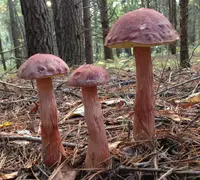
Aureoboletus projectellus
Aureoboletus projectellus
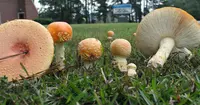
Peach-Colored Fly Agaric
Amanita persicina
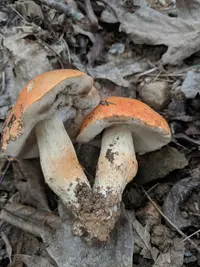
Burnt-orange Bolete
Tylopilus balloui
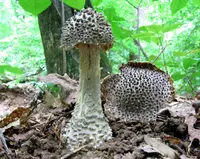
Gunpowder Amanita
Amanita onusta
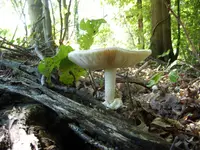
Ravenel's Lepidella
Amanita ravenelii
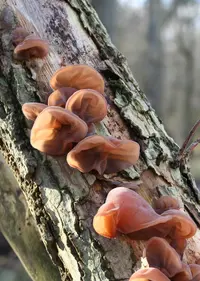
Jelly Ear
Auricularia auricula-judae
Violet Gray Bolete
Tylopilus plumbeoviolaceus