


Host tree pairing
Establish your mycelium only under compatible ectomycorrhizal hosts such as oak, beech, or other native hardwoods, and avoid mixing with conifer litter that can shift soil chemistry and suppress fruiting.

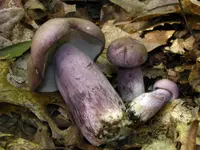
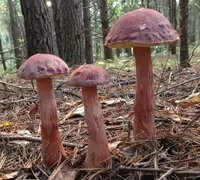
Violet gray bolete, Tylopilus plumbeoviolaceus, is a mycorrhizal mushroom, not a typical houseplant. It forms a partnership with tree roots, helping them absorb water and nutrients. Caps are usually violet to gray-purple, with a thick, pale pore surface instead of gills and a sturdy stem, appearing singly or in small groups on forest floors.
This species occurs mainly in mixed and hardwood forests of eastern North America, often near oaks and other broadleaf trees. It cannot complete its life cycle in a pot, so attempts to care for Violet Gray Bolete indoors are usually unsuccessful.
Violet gray bolete fruits in warm, moist conditions in humus-rich, undisturbed soil. It thrives in shady, stable woodland environments with consistent organic matter and tree partners.

Care Difficulty
Hard Care

Light Preference
Partial Shade

Water Requirements
Regular Water

Temperature Preference
Cool Climate

Hardiness Zone
Unknown

Soil Texture
Loamy, Sandy, Organic-rich

Soil pH
Acidic (5.5–6.5)

Soil Drainage
Moist but well-drained

Fertilization
Minimal (feed rarely)
Scan your plant to receive care tips personalized for your specific plant
Available on iOS and Android
This mycorrhizal mushroom prefers forest light conditions that mimic a mixed or hardwood woodland floor.
This woodland fungus depends on consistently moist, not waterlogged, soil around its tree partners.
This species fruits best in mild to warm woodland conditions with cool nights and no hard frost on the soil surface.
Humidity is not a meaningful cultivation factor for this mycorrhizal fungus, which depends mainly on natural forest floor moisture rather than controlled air humidity.
This ectomycorrhizal fungus fruits best in undisturbed, forest-type soil rather than standard potting substrates.
This species is not suitable for container growing because it relies on extensive mycorrhizal associations with mature trees and large soil volumes that pots cannot provide.
This ectomycorrhizal fungus grows in association with trees and normally does not need direct fertilization when left in natural soil.
Tylopilus plumbeoviolaceus does not require pruning because it is a wild mycorrhizal fungus rather than a managed garden plant.
In cultivation, focus on maintaining suitable host trees and soil conditions rather than moving the fungus itself.
Tylopilus plumbeoviolaceus is rarely propagated intentionally and is usually left to reproduce naturally in forests.
This species is cold hardy in its native range and generally needs no special winter care when growing with suitable host trees.

Plant Health Check
Not sure what's wrong with your plant? Check your plant's health inside the app.
This bolete is known for its strongly bitter taste, which makes it inedible despite having a firm, fleshy cap and pores rather than gills. The bitterness is so pronounced that even a small piece can spoil a mixed mushroom dish.
The pore surface starts a pale lilac to grayish tone and often becomes darker and more dingy with age. When bruised, the pores and flesh may slowly turn brownish, helping distinguish it from some similar purple boletes that stain blue.
This species forms ectomycorrhizae, a mutualistic root partnership, primarily with oaks and other hardwoods in eastern North American forests. It helps trees absorb water and minerals while receiving sugars produced by the host.

Molecular phylogenetic studies have shown that this species, once broadly grouped within the traditional genus Tylopilus, belongs to a more narrowly defined clade, and its classification has been revised as mycologists refine bolete relationships using DNA data.
This bolete is considered inedible due to its very bitter taste, which usually remains even after cooking. It is not known to be dangerously toxic, but eating it commonly causes significant gastrointestinal discomfort and should be avoided.
Keep your plants happy and healthy with plant identification, disease detection, and easy care guidance.

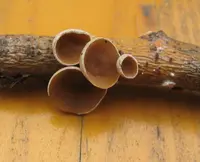
poplar bells
Auriculariopsis ampla
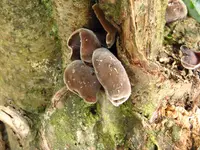
Auricularia nigricans
Auricularia nigricans
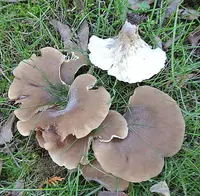
Shoehorn Oyster
Hohenbuehelia petaloides
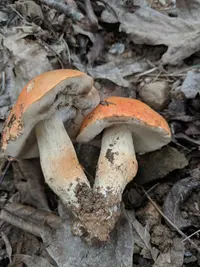
Burnt-orange Bolete
Tylopilus balloui
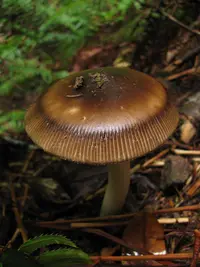
Western Grisette
Amanita pachycolea
Gunpowder Amanita
Amanita onusta
Ravenel's Lepidella
Amanita ravenelii
Aureoboletus projectellus
Aureoboletus projectellus